Contents
A complete TLIF0020-aligned learner workbook. Click any section to jump.
Total reading time: approximately 8–10 hours of focused study (this is a deeper resource than a single TLIF0020 day course; suitable for self-directed study, refresher, or as a teaching reference). Practical assessment: conducted in person on a network-approved training site (Appendix E).
The Rail Industry Worker (RIW) System


Photos via Wikimedia Commons (CC BY-SA): Bidgee, Thebusofdoom, Seo75, Tomoyn.
The Rail Industry Worker (RIW) program is the national workforce-management and competency-verification system used by the Australian rail industry. It is the closest thing rail has to a "passport" for working in or around the rail corridor - a single, electronically-verifiable credential that aggregates a worker's identity, photo, medical fitness, training competencies, network inductions and authorisations into one card-based record.
Before RIW, every major rail operator in Australia maintained its own paper-based or proprietary competency system. A track worker who moved from a Sydney Trains worksite to an ARTC worksite to a Queensland Rail worksite would need three separate inductions, three separate competency files, and three sets of paperwork to prove the same skill. Verification was slow, fraud was common (counterfeit competency cards, expired tickets passed off as current), and there was no real-time way for a site supervisor to check whether the person presenting a card was actually qualified for the work.
The RIW program was launched in 2013–2014 by the major Australian network managers (ARTC, Sydney Trains, Queensland Rail, Metro Trains Melbourne, V/Line and others) jointly with Pegasus Management Group, who operate the system on behalf of industry. It is now mandatory for nearly all corridor access on the major Australian networks, with each network adding its own network-specific competencies on top of the universal RIW base.
What an RIW Card actually is
The RIW Card is both a physical photo-ID card (credit-card-sized, with a magnetic stripe and chip) and a digital record in the central RIW database. The card itself is not the credential - the credential is the database record it links to. The card is simply a convenient, tamper-evident way to identify the worker and trigger a database lookup.
On the front of the card you will find:
- The worker's photo (taken at registration; refreshed at renewal)
- The worker's full legal name
- The worker's unique RIW Universal Reference Number (URN) - a 9-digit identifier that follows the worker for the life of their rail career
- The worker's employer of record (the company who registered them)
- The card's issue date and renewal date (3-year cycle)
- The RIW logo and any high-level safety-critical role indicator
On the back of the card you will find:
- The worker's signature
- The card's magnetic stripe and contact chip (used by Verifier devices on site)
- The card's serial number
- Emergency contact instructions for lost or stolen cards
The card is intentionally simple. It does not list specific competencies or expiry dates for individual tickets, because those change frequently. Anyone who needs to know your competencies must look up your URN in the database (via the RIW Verifier mobile app, or the network's site-access kiosks) - the database is the authoritative source.
The RIW database - what it tracks
The database record behind your URN holds, at any given time:
- Identity: name, photo, contact details, employer of record, emergency contact
- Medical: the category (Cat 1/2/3) of the most recent rail medical, the issuing Authorised Health Professional, the assessment date, the expiry date, any restrictions or conditions
- Drug & alcohol baseline: the result of the most recent baseline D&A screen and any subsequent random or post-incident tests (where the operator participates)
- Competencies: every nationally-recognised unit of competency (TLIF-, TLIRMC-, etc.) the worker has completed, with the issuing training provider, completion date and any expiry
- Network-specific authorisations: e.g. ARTC Worksite Protection Officer, Sydney Trains Rail Industry Safety Induction (RISI), Metro Trains TTSA, Queensland Rail RISI, V/Line PASE
- Active assignments: which projects, contractors and worksites the worker is currently assigned to (helps with emergency mustering and incident investigation)
- History log: a date-stamped record of every site swipe-in and swipe-out across the worker's career on RIW networks
- Notes & restrictions: any temporary or permanent restrictions imposed by an operator (e.g. stand-down pending investigation, exclusion from a specific network for a fixed period)
How verification works on site
When you arrive at a rail worksite or compound, the Protection Officer (or site induction kiosk) will use the RIW Verifier mobile app to check your card. The Verifier:
- Reads your URN from the card (NFC, magnetic stripe, or barcode scan).
- Cross-checks it against the network's competency requirement matrix for that worksite. (Each network defines what competencies it requires for what work - e.g. "Anyone entering an ARTC corridor must hold TLIF0020, current Cat 2 medical, ARTC WP02 induction".)
- Returns a green / amber / red result:
- Green: all required competencies current; medical valid; no restrictions. Site access granted.
- Amber: a non-blocking warning - e.g. medical expires within 30 days, or a competency is approaching expiry. Access granted but worker is alerted.
- Red: a blocking issue - expired competency, expired medical, active stand-down, photo doesn't match. Access refused. The Protection Officer cannot override a Red without a formal exception from the network safety team.
- The swipe is logged against the worker's history; if there is an incident later, the database can show exactly who was on site, when, and what their authorisation was at that moment.
The four tiers of RIW competency
RIW's competency taxonomy operates in four progressive layers. Most workers progress through them in order; specialist roles add further units on top.
Tier 1 - Identification & Card Issue
Your URN is created and a card issued. Requires: 100-point ID check, photo, employer of record nominated, base entry medical (typically Cat 3 minimum). At this point your card is "live" but not yet authorised for any corridor entry.
Tier 2 - National Track Safety Awareness
The base unit of competency for ANY corridor access: TLIF0020 - Safely Access the Rail Corridor (which superseded TLIF2080 in 2020). Known on different networks as TTSA (Metro Trains), NTSA (national), or SARC (legacy). Closed-book classroom test plus practical assessment, ~60 minutes, 100% competency pass mark. Without this, you cannot enter any rail corridor in Australia.
Tier 3 - Network-Specific Inductions
Each major network adds its own induction covering its operational rules, network-specific hazards, signalling system, voltage, communications protocols and emergency response. Common examples: ARTC WP02 (Worksite Protection rules), Sydney Trains RISI (Rail Industry Safety Induction), Metro Trains TTSA, Queensland Rail RISI, V/Line PASE. You must hold the network induction for every network whose corridor you will enter.
Tier 4 - Specialist / Role Competencies
If your role requires you to actively control protection or perform specific safety-critical work, you need additional units. Examples: Protection Officer (Worksite Controller), Lookout, Handsignaller, High-voltage isolation officer, Pilot, Track Vehicle Operator, Signal Maintainer, plant-specific competencies (RIW recognises a wide catalogue of rail-specific plant tickets). Each carries its own training, assessment and currency requirements.
Categories of Rail Safety Worker
The Rail Safety National Law (RSNL) defines a Rail Safety Worker (RSW) as anyone who carries out rail safety work. RIW classifies workers into role-based categories, each of which determines the minimum medical and competency requirements:
- Train Driver / Locomotive Driver - controls trains. Cat 1 medical, full driver competency, route knowledge, vigilance / deadman device training.
- Network Controller / Signaller - operates signals and authorities from a control centre. Cat 1 medical, signaller competency for the specific signalling system.
- Track Worker / Infrastructure Maintainer - performs work on or near the track. Cat 2 medical, TLIF0020, network induction.
- Protection Officer / Worksite Controller - sets up and manages worksite protection. Cat 2 medical, TLIF0020, plus Protection Officer competency for the network's protection rules.
- Lookout - provides warning protection. Cat 2 medical, TLIF0020, lookout competency, vision / hearing screen.
- Plant Operator (rail-bound) - operates Hi-Rail, road-rail vehicles, on-track machines (OTM). Cat 2 medical, TLIF0020, machine-specific competency, network operating rules.
- Contractor / Project Worker (escorted) - survey crews, environmental teams, observers. Cat 3 medical minimum, TLIF0020, network induction; must work under continuous supervision of a competent Protection Officer.
- Non-corridor support staff - office workers, planners, engineers who do not access the corridor. May still register on RIW for identity verification but no medical requirement.
Renewal cycle and what triggers re-assessment
The RIW Card itself is valid for 3 years, after which the worker must renew by repeating any specific competencies that have lapsed and re-confirming their medical and identity. Individual competencies and medicals expire on their own cycles, independent of the card:
- TLIF0020 (track safety): typically reviewed every 2–3 years; some networks require annual refresher
- Network inductions: typically annual or 2-yearly depending on the network
- Cat 1 medical: 5-yearly under 40, 2-yearly 40–49, annually 50+
- Cat 2 medical: 5-yearly under 40, 2–3-yearly 40+
- Cat 3 medical: typically 5-yearly
- Specialist competencies (Protection Officer, Lookout, etc.): typically 2-yearly with formal re-assessment
Re-assessment is also triggered (not just scheduled) by: any notifiable rail incident the worker was involved in; any new health condition or new medication that could affect safety-critical performance; a positive D&A test; a change of network or role; an extended absence from rail work (typically 12 months out, requires re-induction).
Privacy & data handling
RIW is a closed industry system - data is shared between accredited rail transport operators and authorised employers only. Workers can access their own record at any time via the RIW worker portal. Data retention is 7 years after the last activity (typically aligned with workers' compensation limitation periods), then archived in compliance with the Australian Privacy Principles.
Major Australian Rail Networks - Operator-by-Operator
"The Australian rail network" is not a single thing - it is a patchwork of separately-accredited operators, with different track gauges, voltages, signalling systems and operating rules. RIW provides the universal worker-credential layer; each operator adds its own network-specific induction and operating rules on top. Knowing which network you are on, and what's different about it, is fundamental.
| Network | Type / Coverage | Key technical specs | Network-specific induction |
|---|---|---|---|
| ARTC Australian Rail Track Corporation |
Interstate & major freight corridor (Adelaide–Perth, Sydney–Melbourne–Brisbane, Hunter Valley) | Mostly standard gauge (1435 mm); 25 kV AC OHL on electrified sections (Hunter Valley); diesel elsewhere; CTC + ATP signalling | WP02 Worksite Protection Rules; ARTC Network Rules induction |
| Sydney Trains | NSW suburban (Greater Sydney + Blue Mountains, Central Coast, Newcastle, Illawarra) | Standard gauge; 1500 V DC OHL; track circuit + ATP signalling; speeds up to 130 km/h | RISI (Rail Industry Safety Induction) + Sydney Trains specific worksite protection |
| Metro Trains Melbourne | Melbourne suburban (16 lines) | Broad gauge (1600 mm); 1500 V DC OHL; track circuit signalling; speeds up to 115 km/h | TTSA (Track and Train Safety Awareness) |
| V/Line | Victorian regional (passenger + freight) | Mixed broad & standard gauge; mostly diesel; partly 1500 V DC; CTC signalling | PASE (Personal Awareness for Safe Entry) |
| Queensland Rail / TMR | Queensland network (Citytrain in Brisbane + regional + Aurizon-operated freight) | Narrow gauge (1067 mm); 25 kV AC OHL on Citytrain; diesel elsewhere; mixed signalling systems | QR RISI + network-specific worksite protection |
| Public Transport Authority (WA) / Arc Infrastructure | Perth suburban (PTA) + WA freight (Arc, formerly Brookfield) | PTA: narrow gauge, 25 kV AC OHL; Arc: mixed narrow/standard, diesel | Network-specific (WA operates its own Rail Safety Act, separate from RSNL) |
| TasRail | Tasmanian freight (no passenger rail) | Narrow gauge; diesel only; CTC signalling | TasRail-specific induction |
| Aurizon | National freight operator (largest haulage network) | Operates over multiple networks; gauge / voltage varies by network | Aurizon Safe Worker; plus host-network induction |
| Pacific National | National freight (intermodal + bulk) | Operates over ARTC + state networks | PN safety induction; plus host-network induction |
Why this matters operationally: a track worker who moves between Sydney Trains (1500 V DC) and an ARTC freight corridor (25 kV AC, where electrified) needs different no-go-zone awareness, different emergency isolation procedures and different network rules. The base TLIF0020 covers universal principles - but every network induction layers on the local detail. WA is also distinct: it operates outside the RSNL under its own Rail Safety Act 2010 (WA), with its own regulator (the Office of Rail Safety within DMIRS).
Rail Labourer - Victoria Pathway (Skill Set)
"Rail Labourer" is the Victorian entry-level pathway into the rail industry. It is delivered as a nationally-recognised skill set - a bundle of constituent units of competency that together form a complete entry credential. Different RTOs in Victoria package and brand it slightly differently - you may see it called "Rail Labourer", "Rail Track Worker", "Rail Infrastructure - core units", or by skill-set codes such as TLISS00261 - but the constituent units and the outcome are essentially the same: you become eligible for entry-level corridor access work on Victorian rail networks.
The pathway in one diagram


Photos via Wikimedia Commons (Public Domain / CC BY 2.0 / CC BY-SA 2.0): U.S. Army National Guard, "darkday" (Brisbane), Evelyn Simak. Used as illustrative visualisations of the constituent skill-set components.
The constituent units - what each one teaches
TLIF0020 - Safely Access the Rail Corridor
The base rail-safety unit covered comprehensively in Section 5 through Section 13 of this workbook. Track protection, danger zone, OHL clearances, hand signals, detonators, communications, position of safety. ~6 hours of theory + 1 hour practical.
TLIF0019 - Apply low-risk worker isolation procedures
Covers basic lockout/tagout (LOTO) for non-electrical / low-voltage isolation in the rail context. You will learn:
- Identifying energy sources on rail equipment (electrical, hydraulic, pneumatic, mechanical/gravity, stored energy)
- Safe sequence of isolation: notify, shut down, isolate, lock out, tag out, release stored energy, test for dead
- Using personal padlocks (one worker, one lock, one key)
- Group LOTO procedures (lock-box, hasp)
- Restoration sequence (reverse order)
- Emergency lock removal procedure (manager sign-off, worker confirmation)
- Documenting the isolation on the work permit
Practical demonstration: apply isolation to a simulated rail-equipment scenario, including verification.
HLTAID011 - Provide First Aid
Nationally-recognised first aid certificate. Covers:
- DRSABCD primary survey (Danger, Response, Send for help, Airway, Breathing, CPR, Defibrillation)
- Cardiopulmonary Resuscitation (CPR) on adult, child, infant
- Use of an Automated External Defibrillator (AED)
- Bleeding control (direct pressure, indirect pressure, tourniquets)
- Burns (thermal, chemical, electrical) - relevant for rail (OHL contact = electrical burns)
- Spinal injury management (suspect spinal in any fall, train-strike, high-impact)
- Shock, fracture, head injury, asthma, anaphylaxis, snake bite (relevant in rural Victoria)
- Heat-related illness (relevant for summer corridor work)
- Mental health first aid awareness
- Documentation, handover to ambulance
Currency: 3-yearly refresh required to maintain. Combined with HLTAID009 below.
HLTAID009 - Provide CPR
A subset of HLTAID011 focused specifically on CPR. 12-monthly refresh required (more frequent than HLTAID011) because CPR technique is perishable. Practical demonstration on a CPR mannequin: 30 compressions to 2 breaths, 100–120 compressions per minute, depth 5 cm adult / 5 cm child / 4 cm infant. Use of AED.
Manual Handling unit (TLID2003 or equivalent)
Critical for rail labourers because the daily work involves heavy components - concrete sleepers (~250 kg each), rail sections, fish plates, ballast bags, signal heads. Covers:
- TILE assessment (Task, Individual, Load, Environment)
- Safe lifting technique (size up the load, plan the route, bend at hips and knees not back, keep load close, no twisting while lifting)
- Team-lift coordination
- Mechanical aids (sleeper lifters, rail trolleys, gantries)
- Recognising musculoskeletal injury (immediate vs cumulative)
- Reporting and early intervention
CPCWHS1001 - White Card (prerequisite)
The construction-industry safety induction. Required for work on construction sites and forms part of the rail-labourer prerequisite stack. Covered in detail on the White Card page. If you don't already hold one, this is the first thing to obtain - usually a 6-hour day with a Statement of Attainment issued by an RTO.
Career ladder - where the Rail Labourer pathway can lead
Each progression step adds specific units of competency on top of the base. Senior progression also requires demonstrated time-on-tools, performance reviews, and (for some roles) trade qualifications.
What a Rail Labourer actually does - day-to-day
- Track maintenance support - assisting trade-qualified track workers with sleeper renewal, fish-plating, ballast regulation, basic measurements.
- Worksite preparation - setting up barriers, signage, tool storage, clearing vegetation around the work area.
- Materials handling - moving sleepers, rail components, ballast bags, tools to and from the work zone (often using mechanical aids).
- Cleanup & disposal - removing old materials, separating waste streams, disposing of regulated waste (creosote sleepers, scrap metal) to licensed facilities.
- Vegetation management - controlled brush cutting, herbicide spotting (if endorsed), keeping sight lines clear.
- Drainage clearance - clearing culverts and side drains to prevent track flooding.
- Acting as Lookout if you obtain the additional Lookout competency.
- Acting as a worksite labourer for project work - supporting cable laying, signal cabin construction, fence installation, level-crossing upgrades.
Knowledge check: A worker has just completed the Rail Labourer skill set including TLIF0020 and HLTAID011. They have a current Cat 2 medical. They have NOT yet completed V/Line PASE. Can they start work on the Geelong line?
No. Without the V/Line PASE network induction, the worker is not authorised to enter the V/Line corridor - the RIW Verifier will return a Red result. They must complete PASE first. The skill set provides the universal competencies; the network induction provides the network-specific knowledge that V/Line requires before granting site access.Reveal answer
V/Line Network - Operating Context, PASE & Victorian Specifics


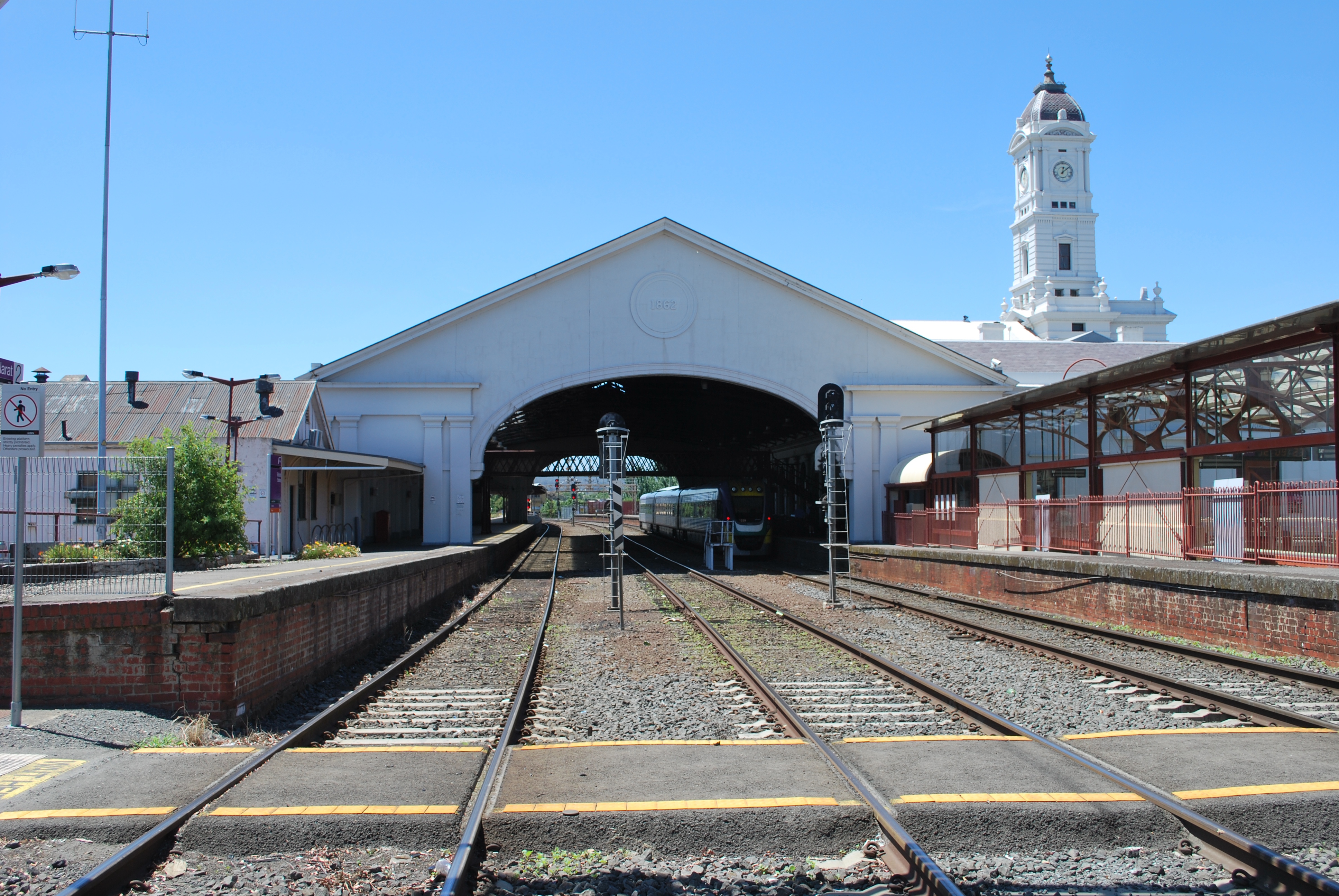

Photos via Wikimedia Commons (CC BY-SA / CC BY): Marcus Wong, Philip Mallis, Mattinbgn, DBZ2313.
V/Line is the operator of Victoria's regional rail network - the long-distance and country routes radiating from Melbourne. It is operationally and culturally distinct from Metro Trains Melbourne (which runs the Melbourne suburban network). A worker certified on Metro Trains is not automatically certified on V/Line, and vice versa - each network requires its own induction. This section covers the Victorian-specific operating context every worker on V/Line corridor must understand.
V/Line route geography
Schematic for orientation only - not to scale. V/Line operates over both V/Line-managed track (regional) and shares some track with Metro Trains (suburban Melbourne) and ARTC (interstate freight corridors). Knowing which network you are on at any given location is critical - the rules and induction differ.
Track gauge in Victoria - broad vs standard
Victoria is one of the most gauge-complicated states. Most V/Line track is broad gauge (1600 mm) - the historical Victorian standard, also used in South Australia. Some sections are standard gauge (1435 mm) - the national interstate gauge connecting to NSW and the ARTC freight corridor. A few critical sections are dual-gauge - carrying three rails so trains of either gauge can use the same route.
Why this matters for workers: on broad-gauge track, the "four foot" between the rails is wider (1600 mm vs 1435 mm), but the danger zone rules are unchanged. On dual-gauge sections, there are three rails - the middle one is shared; tripping hazards are higher; you must be especially careful walking. Gauge transitions occur at specific points; never assume a section's gauge without checking site documentation.


V/Line Personal Awareness for Safe Entry (PASE) - what's covered
PASE is V/Line's network-specific induction. It is required for any worker entering the V/Line corridor, including those who already hold TLIF0020 from another delivery. Typically a 4–8 hour module, classroom + online + practical demonstration. Content covers:
- V/Line as an organisation - structure, key contacts, the V/Line Network Control centre, how V/Line interacts with ARTC and Metro Trains
- V/Line Network Rules - specific operating rules that differ from generic TLIF0020 (e.g. specific PoS requirements at V/Line passing loops, specific protocols for dual-gauge sections)
- V/Line worksite protection - how PO appointments work in V/Line, the V/Line-specific TOA / LPA forms and authority sequence
- V/Line communications - specific UHF/VHF channels, callsigns, escalation procedures
- V/Line rolling stock awareness - VLocity DMUs, locomotive-hauled passenger sets (N-class loco hauling), freight movements over V/Line track, OTM operations
- V/Line route knowledge - the 5 major lines, key junctions, kilometre-post conventions
- Country-specific hazards - livestock straying onto track, kangaroo strikes (one of the most-frequent V/Line incident causes), level crossings on country roads, isolation distance from emergency services, heritage diesel operations, vegetation fires near track
- V/Line D&A program - on-site testing protocols, contracted tester arrangements
- V/Line emergency response - escalation chain, network control numbers, regional ambulance/fire/SES coordination
- V/Line incident reporting - specific notifiable-occurrence reporting paths
- V/Line cultural and environmental obligations - Heritage Victoria sites along corridor, Aboriginal Country crossed by V/Line routes
V/Line route-specific hazards (regional)
| Hazard | Why it matters on V/Line specifically | Control |
|---|---|---|
| Livestock on track | V/Line crosses thousands of km of agricultural land. Cattle, sheep, horses can stray onto track through damaged fencing. | Fence inspections, immediate driver alert, network control to stop following trains |
| Kangaroo strikes | One of the most-frequent collision causes on V/Line. Kangaroos active dawn/dusk, attracted to track gravel for warmth at night. | Driver vigilance, headlight use, warnings; impact damage to leading carriage common |
| Bushfire | Long sections through high-fire-danger country (Wimmera, Gippsland). Trains can be cancelled / rerouted; track inspections post-fire. | CFA coordination, total fire ban day work restrictions, fire-affected sleepers post-event |
| Floods / washouts | Country culverts and low-lying track sections wash out in heavy rain. Particularly Wimmera, Gippsland, Bendigo lines. | Pre-shift weather checks, route inspections during/after rain, rapid network control communication |
| Level crossings - high density | V/Line crosses hundreds of country level crossings, many passive (STOP / GIVE WAY only). Highest fatality risk. | Driver whistle protocols, public education, ongoing crossing-protection upgrades |
| Emergency response distance | Some V/Line sections are 100+ km from the nearest hospital. Self-sufficiency for first aid is critical. | HLTAID011 + AEDs on key routes, helicopter EMS coordination, satellite phones in remote areas |
| Heritage diesel operations | V/Line shares track with heritage operators (e.g. Steamrail Victoria) running historic locomotives. Different braking, sight, and noise characteristics. | Network control coordination, specific worksite notifications when heritage operations active |
| Snake bite risk | Brown snakes, tiger snakes prevalent along V/Line corridors in summer. | Long pants, boots, antivenom kits not on-site (call 000), pressure-immobilisation first aid |
| UV and heat | V/Line workers spend long shifts in open country. Wimmera summer temperatures regularly exceed 40 °C. | Heat speed restrictions for trains, scheduled water breaks for workers, shade structures at long-duration worksites |
| Mobile-signal black spots | Mobile coverage drops in many V/Line corridor sections. Comms failure is a real risk. | Backup radios, satellite phones for remote work, predefined check-in schedule |
Knowing which network you are on
A V/Line shift may take you over multiple networks. From Southern Cross Station outwards, you may transit Metro-managed track, then V/Line-managed track, then in some cases ARTC freight track. Each transition changes the rules - protection arrangements, who you call, what radio channel, what voltages are present overhead. Your pre-work brief should explicitly state which network owns which segment of your worksite. If unclear - ask, do not assume.
Knowledge check: A V/Line track gang is working at Sunshine Station. Sunshine is a Metro Trains-operated station that V/Line trains call at on the Geelong / Ballarat / Bendigo lines. Which network's induction does the gang need?
Both. Sunshine Station is in the Metro Trains-managed corridor, so workers must hold Metro Trains TTSA. If their work also involves V/Line-specific rolling stock or operations, V/Line PASE is required as well. The RIW Verifier will check the requirements for the specific worksite's network and refuse access if either is missing.Reveal answer
The Rail Safety National Law - What the Law Actually Says
The Rail Safety National Law (RSNL) is the legislative backbone of Australian rail safety. Originally enacted in South Australia in 2012, it has been adopted by every state and territory except Western Australia (which operates under the Rail Safety Act 2010 (WA)). It is administered by the Office of the National Rail Safety Regulator (ONRSR), headquartered in Adelaide. Below are the most important sections that every rail safety worker is expected to know.
Section 46–47 - Duties of rail transport operators
"A rail transport operator must ensure, so far as is reasonably practicable, the safety of the operator's railway operations." (s.46)
Plain English: Each accredited operator (Sydney Trains, ARTC, etc.) carries the primary duty of care - the same SFAIRP test as WHS law. They cannot delegate or contract out of this duty. Section 47 extends the same duty to rail infrastructure managers and rolling stock operators.
Section 52 - Duties of rail safety workers
"A rail safety worker must, while at work: (a) take reasonable care for his or her own safety; (b) take reasonable care that his or her acts or omissions do not adversely affect the safety of other persons; (c) comply with any reasonable instruction given by the rail transport operator; (d) cooperate with any reasonable policy or procedure of the rail transport operator relating to safety."
Plain English: Four duties on you (mirror image of WHS s.28). Look after yourself. Don't put others at risk. Follow reasonable instructions. Cooperate with operator procedures (D&A testing, fitness for duty, network rules).
Sections 116–117 - Drug and alcohol testing
The RSNL gives ONRSR and rail operators broad powers to require drug and alcohol testing. The tests apply to any rail safety worker at any time during or before a shift. Refusal to undergo a test is treated the same as a positive result.
- Pre-shift testing: at the operator's discretion. Many operators conduct random pre-shift breath tests on safety-critical staff.
- Random testing: mandatory under operator D&A management plans. Frequency varies but ARTC, Sydney Trains, Metro Trains all conduct routine random testing.
- Post-incident testing: mandatory after any notifiable occurrence. Test results form part of the incident investigation.
- Reasonable cause testing: a supervisor or PO who reasonably believes a worker is under the influence may direct an immediate test.
- Standard: 0.00% BAC. Any positive saliva or urine drug test = stand-down pending investigation.
Section 121 - Fatigue management
The RSNL imposes a specific duty on operators to prepare and implement a fatigue risk management plan for safety-critical workers. This includes shift-length limits, minimum rest breaks, journey management, fatigue self-reporting protocols, and education.
You as a worker have a corresponding duty to manage your own fatigue, declare fatigue when you cannot safely perform safety-critical duties, and not falsify your work-rest record. Fatigue is treated under the RSNL as a near-equivalent to alcohol impairment - 17 hours of continuous wakefulness produces equivalent cognitive impairment to 0.05% BAC.
Section 121A - Notifiable occurrences
The RSNL requires immediate reporting of notifiable occurrences to ONRSR and (where applicable) the ATSB. They are split into two categories:
Category A - Immediately notifiable (within 1 hour, by phone)
- Death of a person from rail operations
- Serious injury (life-threatening or requiring immediate hospital admission)
- Train collision (with another train, road vehicle at level crossing, person, or large object)
- Train derailment
- Significant fire or explosion involving rolling stock or infrastructure
- Dangerous-goods incident affecting safety
- Loss of overhead wiring or signalling failure causing immediate danger
- Any near-miss with potential for catastrophic outcome (e.g. high-speed Signal Passed at Danger / SPAD)
Category B - Routinely notifiable (in the next monthly return)
- Minor SPADs and signalling irregularities
- Track defects discovered through inspection
- Rolling stock defects affecting brake performance
- Minor injuries treated on-site
- Near-misses with low realistic harm potential
- D&A test failures (anonymised)
Any worker who witnesses a notifiable occurrence (or suspects one has occurred) has a duty to report it to their supervisor or directly to network control immediately. The RSNL provides whistleblower protections for workers who report safety concerns in good faith.
Penalties under the RSNL
| Category | Conduct | Maximum penalty |
|---|---|---|
| Cat 1 - Reckless | Recklessly engages in conduct exposing person to risk of death/serious injury | Up to $300,000 + 5 yrs imprisonment (individual); up to $3M (corporate) |
| Cat 2 - Failure with risk | Fails to comply with safety duty; failure exposes person to risk | Up to $150,000 individual / $1.5M corporate |
| Cat 3 - Failure | Fails to comply with safety duty (no exposure) | Up to $50,000 individual / $500,000 corporate |
| Specific offences | Refusing D&A test, falsifying records, breaching prohibition notice | Variable; commonly $20,000–$50,000 |
Source: Rail Safety National Law (South Australia) Act 2012, as in force in adopting jurisdictions. Penalties are indicative and have been periodically updated.
Rail Industry Terminology - Glossary
The rail industry has its own technical vocabulary. The terms below come up constantly in toolbox talks, network rules, and the TLIF0020 assessment. Knowing them is part of being inducted, not optional jargon.
Track and infrastructure
| Term | Meaning |
|---|---|
| Ballast | Crushed stone packed around and under sleepers, providing drainage and load distribution. Loose ballast is a trip hazard; thrown ballast can derail a train. |
| Sleeper | The transverse beam (timber, concrete or steel) that holds the rails to gauge. "Tie" in American usage. |
| Formation | The prepared earthworks subgrade beneath the ballast that supports the track structure. |
| Cess | The walkway / drainage area immediately alongside the ballast shoulder. Often used as a Position of Safety provided clear of the danger zone. |
| Six foot / Four foot | UK-derived terms still common in AU. "Four foot" is the space between the two rails of a single track. "Six foot" is the space between two adjacent tracks. |
| Gauge | Distance between the inside faces of the two running rails. Australia uses three gauges: standard (1435 mm), broad (1600 mm, Victoria), narrow (1067 mm, QLD/WA/SA/TAS). |
| Cant / Superelevation | The amount by which the outer rail is raised above the inner rail on a curve, to counteract centrifugal force at speed. |
| Points / Switch | The moveable rails at a junction that direct trains from one track to another. "Set against you" means the points are aligned for a different route - do not foul. |
| Crossing / Frog | The fixed component at the intersection of two rails (where one rail crosses the other through a junction). |
| Signal | A trackside indicator (light or semaphore) instructing the driver. Red = stop, yellow = caution, green = proceed. Modern systems use multi-aspect colour-light signals. |
| Catch point / Trap point | A safety device that derails a runaway vehicle to prevent it entering an occupied section. |
| Buffer stop | The end-of-track barrier in a siding or terminus. |
| Kilometre post (km post) / Chainage | Linear measurement along a track from a defined origin. Used to specify locations precisely (e.g. "obstruction at 47.250 km on the Up line"). |
| Up / Down | Directional convention. "Up" traditionally means toward the principal terminus (usually the capital); "Down" away from it. Each network defines its own. |
| Loop / Refuge loop | A parallel siding where one train can wait while another passes (on single-line sections). |
Operations and protection
| Term | Meaning |
|---|---|
| RSW | Rail Safety Worker - the legal classification under the RSNL of any worker who carries out rail safety work. |
| Danger Zone | 3 m horizontally from the nearest rail (extended to 6 m if working above 3 m height). The area where you may be struck or come into contact with the train's dynamic envelope. |
| Dynamic envelope | The actual swept volume of a moving train, including overhang on curves and lateral sway. Slightly wider than the static body of the train. |
| Position of Safety / Place of Safety | A pre-identified location clear of the Danger Zone where workers must move on warning. Different terms used by different networks but same concept. |
| SPAD | Signal Passed at Danger - a train passes a signal showing red. One of rail's most serious safety events; every SPAD is investigated. |
| Possession | Formal exclusive occupancy of a section of track for engineering work. Issued by network control. |
| TOA / LPA | Track Occupancy Authority / Local Possession Authority - the formal authority issued for a possession. |
| Block / Block section | A section of track between two signals; only one train at a time may occupy a block. |
| CTC | Centralised Traffic Control - signaller controls signals and points remotely from a single centre. |
| ATP | Automatic Train Protection - on-board system that automatically applies brakes if the driver passes a stop signal or exceeds the speed limit. |
| OHL / OHW | Overhead Line / Overhead Wire - the catenary system supplying electric traction power. 1500 V DC on most AU suburban networks; 25 kV AC on ARTC and QR Citytrain. |
| Pantograph | The spring-loaded current collector on the roof of an electric train that contacts the OHL. |
| Third rail | A conductor rail running alongside or between the running rails, used for traction power on some systems. Always live unless explicitly isolated and earthed. |
| Earth / Ground | To deliberately connect a previously-live conductor to earth, draining residual energy. Required before any work near isolated OHL. |
| Detonator / Torpedo | Small explosive device clipped to the rail; detonates loudly when a train wheel passes over it, alerting the driver to emergency stop. |
| Hi-Rail / Road-rail vehicle | A road vehicle (typically ute or truck) fitted with retractable rail wheels, allowing operation on both road and track. |
| OTM | On-Track Machine - specialised rail-bound construction plant (tampers, regulators, ballast cleaners). |
| Pilot | A competent rail safety worker who escorts a non-competent person or visiting train through unfamiliar territory. |
| Handsignaller / Flagman | A trained worker who provides hand-signal authority at a worksite (e.g. at a level crossing under temporary protection). |
| Toolbox talk / Pre-work brief / RSWHA | The mandatory safety briefing before any corridor work. Covers hazards, controls, protection method, PoS, warning signals, comms plan, emergency plan. |
Regulatory bodies and acronyms
| Term | Meaning |
|---|---|
| ONRSR | Office of the National Rail Safety Regulator - the national rail safety regulator under the RSNL. Headquartered in Adelaide; offices in every state. |
| RSNL | Rail Safety National Law - the national rail safety legislation (every state and territory except WA). |
| ATSB | Australian Transport Safety Bureau - the independent investigator of rail (and road and air) safety occurrences. |
| RISSB | Rail Industry Safety and Standards Board - develops the Australian Standards (AS 7XXX series) used in rail. |
| NTC | National Transport Commission - publishes the National Standard for Health Assessment of Rail Safety Workers. |
| SFAIRP | So Far As Is Reasonably Practicable - the rail equivalent of the WHS "reasonably practicable" test. |
| RIM | Rail Infrastructure Manager - an accredited operator responsible for the track, signals and structures (e.g. ARTC, Sydney Trains as the RIM for the Sydney network). |
| RTO | Rolling Stock Operator (in rail context) - an accredited operator that runs trains over a RIM's network (e.g. Aurizon, Pacific National). NOTE: distinct from "Registered Training Organisation" in VET context. |
| SMS | Safety Management System - the documented operator-wide system for managing rail safety risks; required for ONRSR accreditation. |
| RIW | Rail Industry Worker - the national worker-credential program (this card system). |
| URN | Universal Reference Number - the worker's lifetime 9-digit RIW identifier. |
| AHP | Authorised Health Professional - the doctor accredited by ONRSR to perform rail medicals. |
| D&A | Drug and alcohol - the testing regime mandated by the RSNL. |
SARC - Safe Access to Rail Corridor
The Safe Access to Rail Corridor (SARC) course is one of the foundational competencies for all rail corridor workers. It is based on the national unit of competency TLIF2010 - Apply safeworking rules and regulations to rail functions and is typically the first course a new rail worker obtains.


Photos via Wikimedia Commons (CC BY / CC BY-SA / CC0): DraftSaturn15, Kerry Raymond, Bernard Spragg, Bidgee.
Rail Safety Legislative Framework
Australia's rail safety is governed by the Rail Safety National Law (RSNL), adopted by all states and territories (except Western Australia, which has its own Rail Safety Act). You will study the roles of the National Rail Safety Regulator (ONRSR - Office of the National Rail Safety Regulator), network managers, rail infrastructure managers (RIMs), and rolling stock operators.
The RSNL establishes duties for rail transport operators, including the requirement to maintain a Safety Management System (SMS), report notifiable occurrences, and ensure all workers have appropriate competencies. You will examine the concept of SFAIRP - So Far As Is Reasonably Practicable - which is the risk management standard applied in rail safety.
- ONRSR: Office of the National Rail Safety Regulator - national enforcement body
- All rail operators must hold accreditation from ONRSR
- SFAIRP: So Far As Is Reasonably Practicable - the standard for managing rail risks
- Notifiable occurrences include collisions, derailments, and serious near-misses
- Workers have a duty to report unsafe conditions or acts to their supervisor or network manager
Rail Corridor Hazards and Risk Management
The rail corridor is one of Australia's most hazardous work environments. This module examines the full spectrum of hazards encountered when working on or adjacent to active rail lines, and the control measures required to manage them safely.
Hazards covered in detail include: moving trains (approach speeds, detection distances, noise masking by power tools and equipment); electric traction systems (overhead wiring - 25kV AC on interstate and some suburban networks, 1,500V DC on urban networks, third-rail systems); ballast and track geometry (uneven footing, trip hazards); exposure to diesel and electric locomotive emissions; extreme weather conditions; limited access and egress points; communication failures in noisy environments; and the hazards of working in tunnels, bridges, and below-rail spaces.
- Trains can approach silently at high speed - never assume a line is clear
- Electrified lines may have overhead wiring (OHW) - minimum 3-metre approach distance without isolations
- Third rail (DC power) is flush with the track and invisible at night - treat as live at all times
- Sound masking from tools is a major hazard - always wear communications equipment as directed
- Never step over or between tracks - always walk around the end of a train or use a designated crossing
Track Protection Systems
This is the most critical module in SARC. Track protection describes the system of procedures and physical controls that protect workers in the rail corridor from being struck by a train. Understanding these systems - and your obligations within them - is non-negotiable.
You will study the different forms of track protection available: Absolute Protection (the track is physically isolated and no train can enter - the highest level); Possession (network control has given exclusive occupancy of a section of track); Blocking (used for lower-speed and short-duration work); and Warning systems (lookouts, audible warning devices, and flagger systems used where absolute protection is not in place).
The chain of authority in track protection is examined - from the network control centre to the Protection Officer (Worksite Controller) and then to individual workers. You will understand that no worker may enter the rail corridor until the protection system is formally established and acknowledged.
- Never enter the corridor without confirmed track protection from your Protection Officer
- Absolute Protection: physically isolated track - highest level of safety
- Warning-based protection requires trained lookouts and defined warning times
- Clear warning time must account for your ability to reach a place of safety
- All workers must know their designated place of safety before work begins
Rail PPE and Personal Safety
Rail corridor workers have specific PPE requirements beyond standard construction PPE. You will study the selection and correct use of: high-visibility clothing (minimum Class D/N to AS/NZS 4602.1 in orange or yellow as specified by the network); steel-capped safety footwear; hard hats; hearing protection (essential in high-noise rail environments); and communication devices.
You will also study the rail-specific requirement for fall protection on elevated structures (bridges, viaducts), specific requirements for working in tunnels (lighting, communication systems, emergency refuge points), and the prohibition on using personal electronic devices such as mobile phones without approval in the rail corridor.
- Rail hi-vis must be orange or a network-specified colour - yellow is not always acceptable
- Mobile phones must be turned off or set to silent unless approved by the Protection Officer
- Hearing protection must not prevent you from hearing warning signals
- Tunnel workers must know the location of every emergency refuge point on their worksite
- Never remove PPE while in the corridor, regardless of heat or discomfort
Emergency Procedures in the Rail Corridor
Rail emergencies have unique characteristics. Trains cannot stop quickly - a freight train at 100 km/h may take more than 1 kilometre to stop after emergency braking. This means that emergency procedures must be proactive, not reactive. Workers must act immediately on any warning signal without waiting for visual confirmation of a train.
Emergency scenarios covered include: unplanned train approach (immediate evacuation to place of safety, all workers, no exceptions); personal injury in the corridor (isolate track before rendering assistance if possible, call 000 and network control); electrical emergency (do not touch - call network control for OHW or third-rail isolation); track damage or obstruction; fire on rolling stock; and the procedure for making an emergency call to network control.
- On any warning signal - stop all work, pick up tools, move to place of safety immediately
- Do not re-enter the corridor until protection is re-confirmed by the Protection Officer
- Emergency calls to network control must include: your identity, location, nature of emergency
- A detonator placed on the rail will warn a train driver - know where your site's detonators are kept
- All corridor workers must know the emergency contact number for the network manager
RISI - Rail Industry Safety Induction
The Rail Industry Safety Induction (RISI) is the entry-level induction for all workers new to the rail industry. It is a prerequisite for obtaining SARC and other RIW competencies. It is administered through the RIW program portal.
The RISI covers: an introduction to the Australian rail industry; how the RIW program works; the roles and responsibilities of rail workers, employers, and network managers; an overview of the major hazards in the rail environment; the structure of rail safety legislation; and a summary of what the worker will need to learn in subsequent courses like SARC.
RISI is typically completed in 2–3 hours online and must be passed before any in-person training can commence. It is valid for the life of the worker's RIW registration (subject to any updates the program may require).
Fatigue Management for Rail Workers
Fatigue management is a standalone competency required for rail workers who perform safety-critical tasks, work night shifts, or exceed standard work hours. It is based on the national fatigue risk management framework and aligns with work hours limits set by the relevant enterprise agreements and ONRSR guidelines.
The Science of Fatigue
This module explains the physiological mechanisms of fatigue - how sleep deprivation affects cognitive performance, reaction time, decision-making, and situational awareness. You will study circadian rhythms and the body clock, the compounding effect of sleep debt, and the specific vulnerabilities of shift workers. Research shows that after 17 hours without sleep, performance is equivalent to a blood alcohol concentration of 0.05% - illegal to drive at, and equally dangerous in a rail environment.
- 17 hours awake = 0.05% BAC performance impairment
- Circadian low points: 2–6 am and 2–4 pm - highest risk periods for fatigue-related error
- Caffeine masks fatigue but does not restore cognitive function
- Sleep debt accumulates - one good night's sleep does not fully recover from a week of short sleeping
Fatigue Risk Management in Rail
Rail operators are required under the RSNL to maintain a fatigue risk management plan as part of their Safety Management System. You will study the maximum work hours limits applicable to rail workers (which may vary by network and enterprise agreement), mandatory rest period requirements, the process for reporting fatigue to a supervisor, and a worker's right to refuse safety-critical work if they believe they are impaired by fatigue.
- Workers must self-report fatigue before commencing safety-critical duties
- Supervisors cannot order a worker to perform safety-critical tasks if the worker declares they are fatigued
- Maximum consecutive hours and weekly hour limits vary by network - know your applicable limits
- Travel time to remote worksites counts toward fatigue accumulation
Official Resources & Verified References
Rail safety in Australia is regulated by ONRSR (all states and territories except Western Australia, which has its own rail safety act). The RIW program is the national workforce management system - workers, employers, and network managers all use these primary sources for current requirements.

Rail Medical Categories - under ONRSR
Health assessments follow the National Standard for Health Assessment of Rail Safety Workers (NTC) - Category 1 (train drivers), Category 2 (safety-critical non-driving), Category 3 (track safety critical - general track workers). All must be performed by an ONRSR-recognised Authorised Health Professional (AHP).
Assessment and Medical Requirements
Knowledge and Practical Assessment
SARC assessment includes a written or online knowledge assessment (typically 30–40 questions), a practical component where you demonstrate understanding of track protection procedures, and a scenario-based assessment where you respond to corridor emergencies. Minimum pass mark is generally 80%. RPL is not commonly granted for SARC given its safety-critical nature.
Rail Medical Assessment
All workers accessing the rail corridor must hold a current rail health assessment, completed by an ONRSR-approved medical assessor. The category of medical assessment required depends on your role:
- Category 1: Driving roles (train drivers, shunters) - most stringent requirements
- Category 2: Safety-critical roles (signals, protection officers) - intermediate requirements
- Category 3: General track workers - baseline health requirements including vision, hearing, and fitness
- Category 4: Contractors with limited rail exposure - minimal requirements
Medicals are typically valid for 5 years for younger workers and may be shorter for workers with identified health conditions. The medical assesses vision, hearing, cardiovascular fitness, and the absence of conditions that could cause sudden incapacitation.
Track Protection - Every Method, in Detail
Every rail worksite uses one or more worksite protection arrangements to keep workers safe from train movements. The arrangement is selected by the Protection Officer (Worksite Controller) based on the work, the location, and the network rules. Knowing each one is a TLIF0020 examinable area.
1. Absolute Authority (Track Possession)
What it is: The highest level of protection. The track section is closed to all rail traffic for the duration of the work. No train can enter without specific clearance from the Protection Officer.
How it's established: Network controller issues a written/electronic Track Occupancy Authority (TOA) or equivalent. Physical protection (clips, derail blocks, padlocked points) is installed at every entry to the work block. Hand signals and tail boards mark the boundaries.
Used for: Major construction (re-railing, sleeper renewal, bridge works), works with plant on the track, anything where workers must be repeatedly inside the danger zone.
2. Local Possession Authority (LPA) / Track Occupancy Authority (TOA)
What it is: A defined section of track is taken out of normal traffic for a specific time window, with the Protection Officer holding the authority. Less elaborate than a full Absolute Possession but functionally similar at site.
How it's established: Authority issued by network control, recorded in the protection log, communicated to all worksite personnel at the pre-work brief. Physical protection at the access point.
Used for: Maintenance windows of 1–6 hours, planned outages, signal testing, scheduled inspections.
3. Track Warning System (TWS)
What it is: Trains continue to operate on the track. An automatic warning device (sensor on the rail or near the worksite) triggers an audible alarm when a train is detected approaching, allowing workers time to clear to a Position of Safety.
How it's established: Approved TWS deployed and tested per manufacturer/network procedure. Workers briefed on the sound of the warning, the time available to clear, and the nominated Position of Safety. Sufficient sighting distance must exist.
Used for: Inspections, minor maintenance, surveying - where the work doesn't require workers to be repeatedly in the danger zone.
4. Lookout Working (Lookout Protection)
What it is: A trained Lookout (separate competency unit) is positioned to watch for approaching trains and alert workers using a horn or whistle. The lowest order of protection that still allows trains to run.
Strict prerequisites:
- Sufficient sighting distance - the lookout must see far enough to give workers full warning time to clear (typically calculated as: maximum train speed × warning + clearance time + safety margin).
- Workers must be able to clear to a Position of Safety in 10 seconds or less.
- Lookout must have no other duties.
- Lookout-to-worker communication must be unambiguous and audible above ambient noise.
Used for: Limited - many networks restrict it to short-duration, low-risk inspections. ARTC, Sydney Trains and Metro Trains have progressively phased back lookout-only working in favour of TWS or possessions.
Detonator placement - emergency last-resort protection
When used: Only as emergency back-up - when a planned protection arrangement has failed, when an unplanned hazard appears (a derailment, a stranded vehicle on the line), or when temporary track protection is needed and no other system is in place.
How:
- Three detonators clipped to the running rail.
- Spaced approximately 10 metres apart.
- On the approach side(s) of the worksite, at the calculated braking/warning distance for the line speed (typically 1–3 km clear of the worksite).
- When a train's wheels cross each detonator, a loud bang alerts the driver to stop immediately.
Critical: A driver who hears even one detonator detonate is required to bring the train to a stand and not proceed without further authority. Detonators are NEVER used for routine planned work - they are emergency-only.
Hand signals (in case of radio/comms failure)
Every TLIF0020 candidate must demonstrate they recognise these basic hand signals. They are used between trackside workers, lookouts, and train crews when radios fail or distances are short.
- "All Right" / Proceed: Arm raised vertically above the head, or a green flag/light shown steadily.
- "Stop": Both arms raised horizontally, or red flag/light, or repeated waving of any object. Any unrecognised, abnormal or excited signal must be treated as STOP.
- "Caution / Slow": One arm raised at an angle, or yellow flag/light.
- At night or in poor visibility: Substitute coloured lights for flags - same meaning.
Learn from Real Australian Rail Incidents
The Australian rail industry has a strong safety record - and that record is built on rigorous learning from incidents. Each of the following is a published ATSB or coronial finding. Read each carefully: the lessons map directly to TLIF0020 examinable content.
Case 1 - Track worker fatality, Carlton VIC, 9 December 2003
What happened: A track worker was struck and killed by a train while inspecting points. The lookout system in place did not provide adequate warning time for the line speed.
Why: Sighting distance from the lookout's position was less than the calculated minimum for the train's approach speed; ambient noise from another track masked the warning whistle.
Outcome: Significant ATSB recommendations on lookout calculations, network-wide review of when lookout-only working is acceptable, and accelerated rollout of automated TWS systems.
TLIF0020 takeaway: Lookout protection has strict prerequisites for sighting distance, audibility and clearance time. If any condition is not met, the protection is invalid and a higher order of protection must be used.
Source: ATSB Rail Investigation 2004/006.
Case 2 - Waterfall train derailment, NSW, 31 January 2003
What happened: A four-car CityRail train derailed at Waterfall, killing the driver and six passengers and injuring dozens. The driver had collapsed at the controls due to a previously undiagnosed cardiac condition. The deadman pedal (the pedal that should bring the train to a stand if released) was set to a sensitivity that did not trigger when the driver slumped against it.
Why: Inadequate medical screening (the driver's condition was treatable but undetected); deadman device set to "lenient" sensitivity that allowed continued running with an incapacitated driver.
Outcome: Major reforms to the National Standard for Health Assessment of Rail Safety Workers (now the 2024 NTC standard), strict deadman device standards, and the widespread adoption of vigilance-control systems requiring active driver responses every 30–60 seconds.
TLIF0020 takeaway: The medical category framework (Cat 1/2/3) exists because of incidents like this. Self-reporting any new health condition or medication is a non-negotiable duty for safety-critical workers.
Source: NSW Special Commission of Inquiry into the Waterfall Rail Accident (McInerney 2005).
Case 3 - Trackside worker electrocution, NSW, multiple incidents 2010s
What happened: Multiple incidents across the Sydney Trains and ARTC networks involving workers receiving electric shocks from overhead wiring (1500 V DC and 25 kV AC) - often when working with long conductive items (poles, ladders, antennas) without adequate isolation or earthing.
Why: Approach distances breached, often inadvertently when manoeuvring long materials; OHL not isolated and earthed before work commenced; assumption that distance "looked safe" without measurement.
Outcome: Tightened rules on isolations and earthing, mandatory written isolation permits, and the 3-metre minimum approach distance to all live OHL became a hard rule.
TLIF0020 takeaway: Treat all overhead wiring as live until proven dead by an authorised person who has applied earthing. The 3-metre rule applies to your body, your tools, and any conductive material you are handling.
Source: ONRSR investigations and ATSB rail occurrence reports.
Rail Medical Categories - In Detail
The National Standard for Health Assessment of Rail Safety Workers (current edition: NTC, effective 11 November 2024) defines three categories of medical assessment based on the safety-criticality of the role. Every rail safety worker must hold a current medical at or above the category for their role. Examination is by an authorised health professional.
Tests: Cardiovascular (resting and exercise ECG), full vision (acuity, colour, visual fields), hearing (pure tone audiometry), neurological screen, mental health, sleep apnoea screen, drug & alcohol, BMI & metabolic, sleep history.
Frequency: Every 5 years under 40, every 2 years 40–49, annually 50+.
Triggered review: Required after any new diagnosis, hospital admission, or commencement of certain medications.
Tests: General fitness, vision (less stringent than Cat 1 - colour test still required), hearing, musculoskeletal, drug & alcohol, sleep history.
Frequency: Every 5 years under 40, every 2–3 years 40+.
Triggered review: Same triggers as Cat 1.
Tests: Basic vision & hearing, mobility, drug & alcohol screen.
Frequency: Every 5 years.
Triggered review: After any incident or new diagnosis affecting safety.

Drug and Alcohol - Zero Tolerance
- Blood Alcohol Concentration: 0.00% - not 0.05%, not 0.02%, but zero. A breath test reading anything above will result in stand-down.
- Random testing is mandatory and frequent (especially on networks like Sydney Trains and ARTC).
- Pre-shift, post-incident, and reasonable-cause testing all apply.
- Prescription medications can affect testing - declare them to your doctor at the medical, and discuss with your supervisor before each shift if you are newly on a medication.
- Cannabis testing is on a saliva (oral fluid) basis - can return positive several days after use, even on networks in legal-cannabis jurisdictions.
Self-reporting obligation
Every rail safety worker has a positive duty to self-report any change in their health that could affect safe performance - new diagnoses (cardiac, diabetes, sleep apnoea, epilepsy, mental health), new medications (especially anything causing drowsiness), recent hospitalisations, or any temporary impairment (eye injury, broken limb, infection). Failure to disclose has resulted in dismissal in published cases.
Australian Rail Signal System - Aspects and What They Mean

Rail signals look superficially like road traffic lights but they communicate much more information. Australian networks predominantly use multi-aspect colour-light signals. Older mechanical (semaphore) signals still exist on some regional networks but are progressively being phased out. As a corridor worker you must be able to recognise basic signal aspects, even if you are not authorised to act on them - because they tell you what trains around you are about to do.
The four standard colour-light aspects
Why this matters for corridor workers
- You must NEVER assume a signal is correct for you to enter the corridor. Signals are for trains, not for foot workers. Your authority comes from the Protection Officer, not the signal.
- If a signal is at red in your direction, that does NOT mean it is safe to walk in front of a train approaching from the other direction on a parallel track.
- Counter-direction trains (bidirectional signalling) are common on modern networks - trains can run in either direction on either track.
- If you see a train passing a red signal, treat it as an emergency - report immediately to network control via the Protection Officer.
- Signals can fail to "wrong side failure" (showing more permissive aspect than they should). Designed safety means most failures default to red, but never assume.
Subsidiary signals
- Calling-on signal - small white lights below the main signal, authorising a train to enter an occupied section at very low speed (used in stations).
- Position-light shunting signal - horizontal/diagonal/vertical line of small white lights, used for shunting movements at junctions and yards.
- Limit of shunt indicator - marks the boundary beyond which a shunting movement may not pass.
- Theatre indicator / route indicator - alphanumeric display showing the driver which route the points are set for.
Reveal answer
The next signal in that direction is at red (stop). The train approaching this yellow signal is reducing speed and will be slowing to a stop. This means a train is in or about to enter the section ahead of the red signal. You should treat this as an active corridor and be on heightened alert - even though the train is slowing, it is still moving and may pass you in the danger zone before reaching the red signal.
Communications & Radio Protocol in the Rail Corridor
Communication failures are a leading contributor to rail incidents. The rail industry uses a strict, standardised, positive-response radio protocol - very different from the casual radio culture in mining or construction. Every safety-critical communication must be understood the same way by every party. The protocol below is universal across Australian networks (with minor channel-naming variations).
The structure of every safety-critical call
- Listen first. Make sure the channel is clear - cutting across an active call can mask a critical instruction.
- Identify the receiver. "Network Control, Network Control, this is..."
- Identify yourself. "...Protection Officer Smith, worksite at km 47.250 on the Up line."
- State your message in clear, brief language. "Requesting authority to enter Block A12 for inspection works, 5 personnel."
- End with "over" - signals you have finished and expect a response.
- Wait for the receiver to read back / acknowledge. Do not assume your message was received. The receiver will repeat key facts (location, numbers) before granting authority.
- Confirm the read-back. "Read-back correct, Protection Officer Smith, over."
- Acknowledge end of conversation. "Out" (NOT "over and out" - that's a Hollywood myth).
Phonetic alphabet
The NATO phonetic alphabet is used to spell out track designations, location codes and worker names where there is any risk of mishearing. Memorise this:
| Letter | Word | Letter | Word | Letter | Word |
|---|---|---|---|---|---|
| A | Alpha | J | Juliet | S | Sierra |
| B | Bravo | K | Kilo | T | Tango |
| C | Charlie | L | Lima | U | Uniform |
| D | Delta | M | Mike | V | Victor |
| E | Echo | N | November | W | Whiskey |
| F | Foxtrot | O | Oscar | X | X-ray |
| G | Golf | P | Papa | Y | Yankee |
| H | Hotel | Q | Quebec | Z | Zulu |
| I | India | R | Romeo |
Numbers - pronounced individually
Numbers are spoken digit by digit, NOT as words. "47.250" is "four seven decimal two five zero", not "forty-seven point two-fifty". This avoids mishearing fifteen as fifty (a difference of 35 km of track).
- 0 = "zero" (NOT "oh")
- 3 = "tree" on some networks (to distinguish from "free")
- 5 = "fife" on some networks (to distinguish from "fire")
- 9 = "niner" (to distinguish from "no" or German "nein")
The emergency call - "MAYDAY MAYDAY MAYDAY"
In a life-threatening emergency in the rail corridor, the universal call is "MAYDAY MAYDAY MAYDAY". This call:
- Takes absolute priority over all other radio traffic. All other parties stop transmitting immediately.
- Triggers an automatic response by network control - trains in the affected area are stopped, emergency services are notified.
- Must be followed by: your identity, your exact location (track, direction, km post or chainage), the nature of the emergency, the number of casualties, and what assistance you need.
Example: "MAYDAY MAYDAY MAYDAY. Protection Officer Smith, worksite km 47.250 Up line, derailment, two carriages overturned, multiple injured. Require ambulance and fire. Over."
For lower-priority urgent (but not life-threatening) traffic, use "PAN PAN PAN PAN PAN PAN" - same priority structure but for non-emergency urgency (e.g. derailed empty wagon with no injuries).
The Danger Zone & Overhead Wiring Clearances - Visual Reference
The two diagrams below show the two invisible volumes every rail safety worker must constantly think about: the Danger Zone (struck-by-train risk) and the Overhead Wiring (OHL) approach distance (electrocution risk). Memorise both shapes - the safety of every corridor task depends on staying out of them unless protection is in place.
Danger Zone - standard 3 m, extended to 6 m above 3 m height
The "above 3 m" extension exists because dropped tools, materials, and people have lateral momentum - a tool dropped from a bridge or platform 3 m above the track can land well outside the standard 3 m horizontal danger zone.
Overhead wiring (OHL) clearance - minimum 3 m from any live wire
- 3 m exclusion zone applies in all directions from any live conductor - not just below it.
- Conductive items (long pipes, ladders, antennas, even very long pieces of wood when wet) extend your effective reach - measure the full length you are handling, not your body.
- 25 kV AC can transmit fatal current through ionised air (arc-flash) for up to 1 m even without contact.
- Step potential: if a live conductor falls to ground, a voltage gradient extends ~10 m around the contact point. Walk away with small shuffling steps to keep both feet at the same potential.
- Only authorised HV workers may declare a line "isolated and earthed" - until they do, treat all OHL as live.
Rolling Stock Awareness - Train Types & Behaviour
"Rolling stock" is the industry term for everything that runs on the rails - passenger trains, freight trains, locomotives, on-track machines, hi-rail vehicles. As a corridor worker you don't operate them, but you must understand their physical behaviour: how fast they accelerate, how far they take to brake, how quietly they can approach, what they look like at a distance. Misjudging these is how track workers get killed.
Train types you'll encounter on Australian networks
| Type | Typical configuration | Mass | Top speed | Behaviour notes for corridor workers |
|---|---|---|---|---|
| Suburban EMU (Electric Multiple Unit) | 4–8 carriages, distributed traction (motors under multiple cars) | 250–500 t | 110–130 km/h | Very quick acceleration. Quiet at low speed (electric). High passenger capacity = bigger consequence in collision. |
| Regional DMU/DEMU (Diesel/Diesel-Electric MU) | 2–6 carriages, e.g. V/Line VLocity, QR tilt train | 150–350 t | 130–160 km/h | Audible diesel engines, but masked by tunnel/cutting acoustics. Long braking distances at speed. |
| Locomotive-hauled passenger | 1–2 locos + 4–14 carriages (e.g. XPT, Indian Pacific, Ghan) | 500–900 t | up to 160 km/h (XPT) | Heavy. Long. Requires more braking distance than EMUs of similar speed. |
| Freight (intermodal) | 1–3 locos + 50–100 wagons (containers) | 3,000–7,000 t | 80–115 km/h | Massively heavier than passenger trains. Braking distances 1.5–3 km at line speed. Often runs at night. |
| Freight (bulk - coal, iron ore, grain) | 1–4 locos + up to 240 wagons | up to 30,000 t (Pilbara iron ore); 8,000–15,000 t typical AU coal | 60–90 km/h | The longest, heaviest trains in Australia. Visual length over 2 km. Braking distance 2–4 km. Cannot stop quickly under any circumstance. |
| On-Track Machine (OTM) | Tampers, regulators, ballast cleaners, switch tampers | 50–200 t | typically ≤ 60 km/h | Operated by a competent operator under track protection. May be working in an active section under possession. |
| Hi-Rail / Road-Rail Vehicle | Ute or truck with retractable rail wheels | 3–15 t | typically ≤ 40 km/h on rail | Smaller and quieter than a train but still operates under track protection. Driver requires rail-vehicle competency. |
| Light rail / tram (Sydney, Melbourne, Adelaide, Gold Coast) | 1–3 articulated cars | 30–80 t | 50–80 km/h | Operates on street and segregated alignments. Different rules apply - covered in light-rail-specific inductions. |
Braking distance - the central rolling-stock fact
A train cannot stop suddenly. The braking distance - from first brake application to standstill - depends on speed, mass, gradient, brake condition, and whether the brakes are applied as a service stop or an emergency stop. The figures below are indicative emergency-stop distances on level track; gradients add or subtract significantly.
| Train type | Speed | Emergency stop (level track) | Equivalent in city blocks |
|---|---|---|---|
| Suburban EMU (8-car) | 80 km/h | ~ 350–500 m | 3–5 city blocks |
| Suburban EMU (8-car) | 130 km/h | ~ 700–900 m | 7–9 city blocks |
| Regional DMU (VLocity) | 160 km/h | ~ 1,100–1,400 m | 11–14 city blocks |
| XPT / NR-loco passenger | 160 km/h | ~ 1,300–1,700 m | 13–17 city blocks |
| Intermodal freight (5,000 t) | 100 km/h | ~ 1,800–2,500 m | ~ 2 km |
| Bulk coal train (12,000 t) | 80 km/h | ~ 2,500–3,500 m | ~ 3 km |
| Pilbara iron ore (30,000 t) | 75 km/h | ~ 3,500–5,000 m | ~ 4–5 km |
Implication: if a freight train driver sees you at 800 m on a level track, the train may already be unable to stop short of you. Never assume the driver can avoid you. The protection arrangement is your safety, not the driver's eyesight.
Sight distance - how far a train can be seen approaching
- Straight, clear track in daylight: a train is typically visible from 1–2 km away.
- Curved track: sight distance can collapse to under 200 m. Calculate from the geometry; never assume.
- In tunnels and cuttings: sight distance can be effectively zero until the train is on top of you.
- In rain, fog, low light: reduce visual sight distance by half or more.
- In high ambient noise (machinery running, generators, road traffic, OHL hum, plant on adjacent tracks): your hearing sight distance also collapses. You may not hear an approaching train at all until it is metres away.
- Modern EMUs are very quiet at low speed (electric, no engine noise). The first sound you may hear is the air rushing past the leading carriage - by which time it is on top of you.
Knowledge check: A regional VLocity is approaching at 160 km/h. The lookout's required warning time (to allow workers to clear to the cess) is 25 seconds. What sighting distance does the lookout need?
160 km/h = 44.4 m/s. 44.4 m/s × 25 s = ~1,111 metres of sight distance required. If the lookout's actual sight distance is less than that (curve, vegetation, structure blocking view), lookout-only working is invalid for that worksite. Add a safety factor and you'd want at least 1,300 m clear.Reveal answer
Weather & Environment Procedures
Weather affects rail safety in ways that are specific to the corridor environment - track expansion, traction reduction, visibility loss, lightning hazards on overhead wiring, bushfire encroachment. Each network publishes weather-triggered operating restrictions; the rules below are universal across Australia.
Heat - track buckling risk
- Continuous Welded Rail (CWR) - the standard track form on most Australian networks - expands lengthwise as it heats. Above ~38°C ambient (rail temp can reach 60°C), trains may be subject to heat speed restrictions (typically reduced to 60–80 km/h).
- Above ~45°C ambient, some operators impose all-stop on certain corridors until temperature drops.
- Buckling can happen suddenly - the rail snakes out of alignment as it has nowhere to expand. Trains derail.
- Workers in heat: minimum hydration, scheduled breaks in shade, watch each other for heat stress (confusion, nausea, cessation of sweating). Heat-related illness in heavy hi-vis PPE in the Australian summer is a leading cause of rail-worker incident.
Wet weather - reduced traction & visibility
- Wet rail reduces braking traction; emergency-stop distances increase by 20–40%.
- Visibility for both drivers and workers drops sharply in heavy rain.
- Cess and drainage can flood - a "Position of Safety" that's normally dry may be ankle-deep in water, unstable footing.
- Underground tracks (subways, tunnels, cuttings) can flood rapidly during severe rain - drowning is a real risk.
- Electrified networks: water on insulators can cause flashover. Stay clear of any water dripping from OHL infrastructure.
Lightning - the OHL hazard
- Overhead wiring is essentially a long lightning conductor. Strikes can travel kilometres along the wire.
- When lightning is within ~10 km of the worksite, electrified-corridor work normally stops.
- Take shelter away from OHL, away from trees, in a building or vehicle.
- Crouch low if no shelter is available; do NOT lie flat (ground current).
- Resume work only when the storm has been clear for ~30 minutes after the last lightning observed.
High wind
- Tall plant (cranes, EWPs, OTMs with raised attachments) becomes unstable in winds above ~40 km/h. Manufacturer's wind limits apply.
- Trees and signage can fall onto track or workers.
- Loose materials become projectiles; secure all toolboxes, paperwork, light objects.
- Long-span bridges may have specific wind speed restrictions for both train operations and worker access.
Bushfire
- Trains are routinely cancelled or rerouted in active fire areas.
- Hot work (welding, grinding, cutting) is restricted on Total Fire Ban days - a Hot Work Permit may be required even on cleared corridor.
- If a fire approaches the worksite: stop work, withdraw via the pre-briefed escape route, don't try to drive across an active fire front.
- Smoke reduces visibility - both for drivers spotting workers, and for workers spotting trains.
- Many recent Australian rail incidents have involved fire-damaged sleepers, twisted rails post-fire (heat-affected), and cable damage. Post-fire, the corridor must be inspected before reopening.
UV exposure
The Australian sun is the highest-UV environment on the planet. A full corridor shift in the open is equivalent to many hours of unprotected sun exposure. Skin cancer is the most preventable occupational disease in rail. Mandatory: SPF 50+ sunscreen reapplied every 2 hours, broad-brim hat (or hard-hat brim attachment) on hot days, long-sleeve hi-vis, UV-protective safety glasses.
Work-Type Specific Procedures
The base TLIF0020 covers universal corridor safety. Specific work types have their own additional procedures, hazards and competencies. You will not perform these tasks unless you hold the additional ticket; this section is awareness only.
Track maintenance - tamping, ballast cleaning, sleeper renewal
- Tamping consolidates the ballast under sleepers. Performed by an OTM (tamper) under track possession. Workers in the area must wear hearing protection (very loud) and stay clear of the machine's swing area.
- Ballast cleaning/regulation - removes contaminated ballast and re-profiles the shoulder. Heavy plant, dust, flying ballast hazards.
- Sleeper renewal - old timber/concrete sleepers replaced. Manual handling hazards (concrete sleepers ~250 kg), lifting plant, pinch points.
- Rail replacement / re-railing - long welded sections moved by gantry. Heavy lifting, swing zones, slip/fall.
- All of these require full possession typically - lookout-only working is not appropriate.
Signal & cable work
- Working on signalling installations - signals may be commanded to "out of order" by the signaller; trains then operate under specific rules.
- Cable work near track - cables can be high-voltage power, signalling, or communications. Misidentified cable cuts can blackout a network.
- Working in signal cubicles - confined-space-like environment, electrical hazards, isolation procedures critical.
- Always confirm with the signaller before working on or near any active signalling component.
Overhead Line (OHL) maintenance
- Done by Authorised HV workers under specific isolation and earthing procedures.
- Typically requires a traction power outage from the network controller, with formal isolation on each OHL section.
- Work at heights on EWPs or specialised OHL towers; fall-arrest mandatory.
- Even after isolation, the OHL must be earthed at both ends of the work zone before being treated as dead.
- Adjacent track OHL may still be live - the 3 m exclusion zone applies.
Bridge and tunnel inspection
- Bridge work - full possession plus fall arrest if working over the edge. Snooper trucks (under-bridge inspection units) used for major structures.
- Tunnel work - ventilation must be assessed (diesel exhaust, dust, oxygen). Lighting required. Communications often degraded; may need wired comms.
- Confined-space-like considerations may apply in service tunnels and ducts.
Working on or near level crossings
- Two simultaneous hazards: rail movements AND road traffic.
- Boom gates, lights and bells must be tested before any disabling.
- If protection equipment is taken out of service, manual flagging by certified handsignallers is required at every approach.
- Public road safety - warning signs, traffic management plan, SafeWork notification may be required for adjacent road works.
Level Crossings - The Highest-Frequency Public Hazard
Level crossings are where the public meets the rail. Australia averages ~30 level crossing collisions per year, with around 5–10 fatalities. Many more "near misses" go unreported. The Office of the National Rail Safety Regulator considers level crossing safety one of its top priorities. As a corridor worker, you may be required to work on or near level crossings; you should also understand them as a member of the travelling public.
Types of level crossings
| Type | Protection level | Where used |
|---|---|---|
| Active crossing - boom gate + flashing lights + bell | Highest | Major roads, urban networks |
| Active crossing - flashing lights + bell only (no boom) | Medium-high | Lower-traffic crossings, regional |
| Passive crossing - STOP sign + crossbuck only | Driver responsibility | Rural, remote, low-traffic |
| Passive crossing - GIVE WAY sign + crossbuck | Driver responsibility | Very low traffic, sight distance available |
| Pedestrian crossing - maze gates / pedestrian boom | Variable | Stations, urban areas with foot traffic |
| Private level crossing | Variable | Farm, industrial sites accessing across tracks |
Common public crossing failures (and the lessons)
- Driving around descended booms - the leading cause of level crossing fatalities. Education campaigns ("Don't Risk It") run continuously. Heavy fines + criminal liability.
- Misjudging train speed - trains look slower than they are because of their size. A train at 100 km/h looks slow at distance.
- Second train - one train passes, driver assumes safe, doesn't see another approaching from the other direction. Boom stays down.
- Trapped on the crossing - vehicle queuing across the crossing; lights start when nowhere to go. Always leave space; never enter unless you can clear.
- Heavy vehicle / agricultural equipment - long, slow vehicles take longer to clear. Trucks must call ahead of certain crossings to confirm safe to cross.
Worker responsibilities at a level crossing worksite
- If protection equipment (lights/booms) is to be taken out of service, you cannot do this without authorisation from the signaller and substitute manual protection (handsignallers).
- Handsignallers must wear high-visibility, hold red/green flags or paddles, and be trained in the specific crossing's procedures.
- Public communications - advance notice signs, social media notification, road authority coordination.
- Rolling stock approaching a worksite at a level crossing must whistle (one long blast) approximately 400 m out, then again 200 m out.
Real Australian Rail Infrastructure - Visual Reference
The photos below show the real infrastructure types referenced throughout this workbook. Familiarise yourself with how each looks in practice - recognising them on first sight is part of being competent in the corridor.


Photos via Wikimedia Commons (CC BY / CC BY-SA): Dicklyon, Stephen Edmonds, Ymblanter, Philip Mallis, Dietmar Rabich, Florian Pépellin.
Position of Safety - Scenarios by Track Configuration
Identifying a valid Position of Safety (PoS) is one of the most safety-critical decisions a track worker makes. A PoS must be: clear of the Danger Zone of every track that could be occupied, reachable in 10 seconds or less, stable footing (not in a cess that floods, not on loose ballast), and visible to and from the Lookout. Below are the standard configurations, with the specific PoS for each.
A. Single-line track with cess on both sides
Valid PoS: either cess, provided clear of Danger Zone (3 m from nearest rail) and stable. Movement on warning: straight back to whichever cess is closer.
B. Double-line track (Up + Down) with cess on outside only
Valid PoS: outer cess on either side. Six foot is NOT a Position of Safety - the Danger Zones of the two tracks overlap there. Movement on warning: always to the outer cess on the side opposite the warning train.
C. In a tunnel
Valid PoS: a pre-marked tunnel refuge bay (every Australian rail tunnel has them at regulated intervals - typically every 25 m). You must locate every refuge on your worksite at the pre-work brief. Movement on warning: to the nearest marked refuge in the direction AWAY from the approaching train.
D. On a bridge or viaduct (no cess)
Most bridges have NO Position of Safety on the bridge itself. Workers must be either:
- Off the bridge entirely (work scheduled with full possession only), OR
- Behind a designated bridge refuge bump-out (only on some modern bridges), OR
- Working in an EWP suspended outside the bridge edge (with separate fall-arrest)
If your work requires you to be on the bridge with a train possible, then track protection MUST be Absolute Authority (full possession) - lookout-only working on a bridge is not safe.
E. In a cutting / between retaining walls
Often there is a narrow cess but no easy escape route up the cutting. Pre-identified climb-out points or refuge bays must be confirmed at the pre-work brief. If neither exists for your section, lookout-only working is not appropriate - a higher protection level is required.
Reveal answer
The protection arrangement is invalid for the worksite. The "six foot" is NOT a Position of Safety, and if there is no cess or refuge reachable in 10 seconds, lookout-only working should never have been authorised. The worksite should have been operated under a higher level of protection (Track Warning System with auto-warning, Local Possession, or Absolute Authority). The Protection Officer who set up this worksite has made an error. Stop work, retreat to the nearest station, and escalate.
Hand Signals & Detonator Placement - Visual Reference
Hand signals (used when radio fails or distances are short)
By night: green light steady.
Critical: any unrecognised or excited signal MUST be treated as STOP.
By night: yellow light steady.
Critical interpretation rule: if you see ANY signal you don't fully recognise, or the signaller is moving abnormally / excitedly / unclearly - treat it as STOP. Bring the train or movement to a controlled stand. Sort out what the signal meant after you are stopped.
Detonator placement - emergency last-resort protection
When all other protection has failed, or no protection is in place and an emergency arises, three detonators clipped to the rail will warn an approaching driver to stop. Placement is critical: too close to the worksite and the train cannot brake in time; too far and the driver may pass the worksite without realising why they were warned.
| Line speed | Recommended distance from worksite to nearest detonator (Det 1) |
|---|---|
| 60 km/h | ~ 600 m |
| 80 km/h | ~ 800 m |
| 100 km/h | ~ 1,200 m |
| 130 km/h | ~ 1,800 m |
| 160 km/h | ~ 2,400 m |
- Three detonators total, spaced approximately 10 metres apart.
- Placed on the approach side of the worksite.
- Closest detonator (Det 1) at the calculated braking distance for the line speed.
- Three detonations - not two, not one - must be heard by the driver to ensure the warning is unambiguous (a single cracked sleeper or other anomaly might cause one bang).
- For bidirectional running - place detonators on BOTH approach sides.
- If detonators are placed on a track adjacent to the worksite (rather than the worksite track itself), they protect against a wrong-line train movement (rare but possible).
- Once placed, detonators must be removed by the same competent person who placed them after the emergency is resolved. They must be properly stored (not left on the track to be detonated by a service train).
Emergency Response - Step-by-Step Flowcharts
Time matters more than anything else in a rail emergency. The flowcharts below give the standard immediate response for the four most common emergency scenarios you may witness in the corridor.
Scenario 1: Worker struck by train (or suspected serious injury)
- Check Danger - is the train clear, has it stopped, are there other approaches? Don't become a second casualty.
- Send for help - MAYDAY MAYDAY MAYDAY radio call to network control with location, nature, casualties.
- Call 000 - in parallel, dispatch someone (or via the same radio call asks network control) to call 000 for ambulance.
- Stop all rail movements - network control must halt all trains within the affected protection block; if they cannot be reached, place detonators in BOTH directions.
- Apply DRSABCD first aid if you are trained - do not move the casualty unless required to remove from danger.
- Preserve the scene - do not move equipment or evidence once the casualty is stable. The investigation begins immediately.
- Account for everyone - the Protection Officer's worker list is the source of truth. Confirm everyone is accounted for.
- Notify employer - once emergency services are in control.
- Submit notifiable occurrence report - within 1 hour by phone (Cat A under RSNL).
Scenario 2: Worker contacts overhead wiring (electrocution)
- DO NOT TOUCH THE CASUALTY. They may still be in contact with a live conductor. Touching them will electrocute you.
- Assume the casualty and surrounding ground is energised - a "step potential" voltage gradient exists out to several metres around any contact point with high-voltage equipment.
- MAYDAY MAYDAY MAYDAY radio call - specify "electrical contact". Network control must initiate emergency OHL isolation and earthing.
- Do not approach the casualty until network control has confirmed isolation AND earthing has been applied by an authorised HV worker.
- Once confirmed isolated and earthed: apply DRSABCD. Electrocution casualties almost always need CPR and an AED.
- Even after isolation, treat the equipment as live until you have personally confirmed the earthing applied.
25 kV AC overhead wiring can transmit fatal current through ionised air for a distance of up to 1 metre. The 3 m exclusion zone exists for very good reasons.
Scenario 3: Fire on a stationary or slow-moving train
- Evacuate the area - trains may carry diesel fuel, batteries, lithium-ion (modern stock), passengers, freight (potentially dangerous goods). Move at least 100 metres clear, upwind.
- MAYDAY MAYDAY MAYDAY radio call - specify "train fire", train number if known, location, presence of passengers/dangerous goods.
- Call 000 in parallel for fire and ambulance.
- Halt other rail movements - network control will manage isolation.
- If the fire is small AND you are trained AND you have the correct extinguisher AND you have a clear escape - you may attempt to fight it. Otherwise, evacuate and let fire services handle it.
- Account for all workers; stand by for fire services to take command.
Scenario 4: Witness a derailment, collision or near-miss
- Move clear of the immediate area - secondary derailments and rolling debris are common.
- MAYDAY MAYDAY MAYDAY if there is risk to life. PAN PAN PAN PAN PAN PAN if no apparent injuries but trains affected.
- State location, what you saw, train(s) involved, apparent damage and casualties.
- Do not approach the wreckage - OHL may be torn down, dangerous goods may have spilled, fuel may be leaking. Wait for emergency services and isolation confirmation.
- Place detonators in both directions if no other protection is in place - this prevents secondary collisions from following trains.
- Stand by to assist emergency services (e.g. by holding a radio with the network controller) but do not enter the immediate area.
- You will be required to give a witness statement. Make brief contemporaneous notes immediately while memory is fresh.
Drug & Alcohol Testing - Procedures in Detail
Beyond the headline rule (BAC 0.00, zero illicit drugs), there is a defined procedural framework that protects both the worker and the operator. Every rail safety worker should know how testing actually happens, what a positive result triggers, and how to manage prescription medication legitimately.
When you may be tested
- Pre-shift: at the operator's discretion, including random selection. Common on safety-critical sites.
- Random: mandatory under operator D&A management plans. Frequency varies (e.g. quarterly target on Sydney Trains).
- Post-incident: mandatory after any notifiable occurrence. Test results form part of the investigation. You cannot refuse, even if injured (testing happens at hospital).
- Reasonable cause / for-cause: a supervisor or PO who reasonably believes you are impaired may direct an immediate test.
- Return to duty: after a stand-down, before resuming safety-critical work.
How testing works - the chain of custody
- The Authorised Tester (typically a contracted occupational-medicine provider, accredited under AS 4760 / AS/NZS 4308) attends site.
- Worker is identified by photo ID and RIW URN; consent and acknowledgement are recorded.
- Alcohol: evidential breath analyser; result printed and signed. Reading > 0.00 = positive.
- Drugs: oral fluid (saliva) screen for THC, methamphetamine, opiates, cocaine, benzodiazepines. Initial screen; if positive, sample is sent to a NATA-accredited lab for confirmation by mass spectrometry.
- Chain of custody form tracks the sample from collection to lab to result. Both the worker and the tester sign at each handover.
- Worker is offered a split-sample option for independent re-testing if the initial confirmation is positive.
- Results returned within 1–5 business days (alcohol immediately).
What a positive result triggers
- Immediate stand-down from safety-critical duties.
- Confidential medical review with an Authorised Health Professional (AHP).
- Investigation by the operator into the circumstances. Outcomes range from formal warning + retraining + return-to-work plan, through to dismissal in serious cases.
- If the worker is on a permanent restriction (e.g. medication that cannot be stopped), reassignment to non-safety-critical duties may be possible.
- Notifiable to ONRSR in aggregate (not individually) for industry trend analysis.
- The worker's record is flagged on the RIW database; future testers will be aware (privacy-protected detail).
Refusing a test
Refusing to undergo a directed D&A test has the same consequences as a positive result. The Rail Safety National Law explicitly equates the two. There is no defence other than a documented medical incapacity to provide a sample (e.g. cannot produce saliva due to a medical condition; alternative testing then offered).
Prescription medication - the legitimate management path
- Many common medications can produce positive D&A test results: codeine-based painkillers, benzodiazepines (Valium, Xanax), some antihistamines, ADHD medications, opioid pain management.
- Disclosure to your AHP at every medical, AND to your supervisor before each shift if you are newly on a medication, AND to the tester at the time of testing.
- The AHP will assess whether the medication permits safety-critical work. If yes, your record is flagged as "medication: cleared for safety-critical with [name of drug]". You can then test positive without consequence, provided you have disclosed.
- Cannabis (medicinal): even where lawful in your state, it is treated as a positive result for D&A test purposes - the testing methodology cannot distinguish medicinal from recreational use. Medical cannabis users typically cannot perform safety-critical rail work.
Detection windows - how long can substances be detected?
| Substance | Saliva detection window | Urine detection window |
|---|---|---|
| Alcohol | ~12 hours | ~12 hours |
| THC (cannabis) - occasional use | ~12–24 hours | ~3–7 days |
| THC - daily use | ~24–48 hours | ~30 days |
| Methamphetamine | ~24–48 hours | ~3–5 days |
| Opiates | ~6–24 hours | ~2–3 days |
| Cocaine | ~24 hours | ~2–4 days |
| Benzodiazepines | ~12 hours | ~3–7 days |
Detection windows are indicative; actual times vary by individual metabolism, dose, frequency. The bottom line: if you used at the weekend, you can still test positive on Tuesday. The only safe approach is abstinence from non-prescribed drugs.
Incident Investigation & the "Just Culture" Framework
When something goes wrong in rail, the investigation begins immediately. As a worker, you may be a witness, an involved party, or both. Understanding how investigations work - and the principles that govern them - protects you and helps the industry learn.
Who investigates what
- The operator investigates every incident on its network. Internal investigations form the basis of corrective action.
- ONRSR investigates compliance breaches and serious notifiable occurrences. Has powers of entry, document seizure, witness compulsion.
- ATSB (Australian Transport Safety Bureau) investigates major transport-safety occurrences. ATSB investigations are no-blame - their sole purpose is to determine cause and prevent recurrence, not to apportion fault. ATSB findings cannot be used in legal proceedings.
- State Coroner investigates any death.
- Police investigate where criminal conduct is suspected.
- The four often run in parallel; their evidence-handling procedures differ.
"Just Culture" - the foundational principle
Modern rail safety is built on the principle of Just Culture, developed by Professor James Reason. It distinguishes between:
- Honest mistakes - competent worker, normal conditions, error of action or perception. Investigated for system causes; no individual sanction.
- At-risk behaviour - worker takes a shortcut that has become normalised. Investigated for cultural and supervisory causes; coaching and retraining.
- Reckless behaviour - conscious disregard of substantial risk. Disciplinary action applies.
- Deliberate violation - intentional rule-breaking, often for personal benefit or to harm. Severe disciplinary; potentially criminal.
The implication: reporting your own mistake is encouraged. Workers who self-report errors and near-misses, even ones they caused, are protected from punitive consequences in genuine error categories. This is what enables the rail industry to learn. Operators who punish honest mistakes destroy reporting culture and become more dangerous over time.
Your obligations as a witness
- Cooperate fully with all investigators. You have a legal duty to do so under the RSNL.
- Make contemporaneous notes immediately while memory is fresh. Date, time, what you saw, what you heard, what you did. Keep these notes - they are evidence.
- Don't speculate. State only what you actually saw or heard, not what you think happened or what someone else said.
- Don't discuss the incident with other witnesses before giving your statement; you can taint their recollection (and yours).
- Be honest about your own actions, including any errors. Just Culture protects honest reporting.
- Request union representation or a support person for any formal interview. This is your right.
- Care for yourself. Witnessing a serious incident is traumatic. Take EAP / peer support; don't push through alone.
Common investigation findings - the "human factors" framework
Rail investigations rarely conclude with a single cause. Modern thinking (after the Reason "Swiss Cheese" model) recognises layered causes:
- Latent conditions - design flaws, incomplete procedures, training gaps, fatigue-inducing rosters. Present long before the incident.
- Active failures - the immediate worker error or rule violation. The "sharp end".
- Defences - barriers that should have prevented the harm: signals, training, supervision, PPE. Investigations look at why each defence failed to stop the cascade.
The corrective action is almost always at the latent / system level, not individual blame. Replacing the rostering system, redesigning the procedure, adding an automatic train protection layer.
Mental Health, Fatigue & Worker Support
Rail safety work is psychologically demanding. Long hours, night shifts, isolation, the consequences of error, exposure to suicide-related fatalities (Australian rail experiences a tragic number per year), and witness trauma all take a toll. The industry now treats mental health as a safety issue, not a personal one.
The mental health hazards of rail work
- Witness trauma - exposure to fatal incidents, particularly trespasser fatalities and suicide events. Drivers are particularly affected; statistics suggest most long-serving drivers will witness at least one fatality.
- Shift work disorder - circadian rhythm disruption from night shifts, rotating rosters, early starts. Can cause persistent fatigue, depression, metabolic syndrome.
- Isolation - remote work, lone working, long absences from family.
- Pressure - the consequences of error are severe; the anxiety associated with safety-critical decision-making is high.
- Stigma - rail (like construction and mining) has historically had a "hard man" culture that discouraged help-seeking. This has improved markedly since 2010 but is still present.
Recognising distress - in yourself and colleagues
- Persistent low mood, withdrawal, irritability
- Sleep disturbance, fatigue not relieved by rest
- Increased alcohol or drug use
- Reduced concentration, near-misses or errors at work
- Loss of interest in normally-enjoyed activities
- Self-isolation from family, friends, workmates
- Talk of hopelessness, being a burden, "everyone better off without me"
- Reckless behaviour, increased risk-taking
- Giving away prized possessions
Support resources (Australian)
| Service | Contact | What it's for |
|---|---|---|
| Lifeline | 13 11 14 | 24/7 crisis support & suicide prevention - for ANY level of distress |
| Beyond Blue | 1300 22 4636 | 24/7 mental health support & information |
| MATES in Construction | 1300 642 111 | 24/7 industry-specific peer support, also covers rail and mining workers |
| 13YARN | 13 92 76 | Aboriginal & Torres Strait Islander 24/7 crisis support |
| Suicide Call Back Service | 1300 659 467 | For people thinking about suicide or who have lost someone |
| Your operator's EAP | (varies - obtain at induction) | Free, confidential counselling for you and your immediate family. ARTC, Sydney Trains, Metro Trains and others all provide EAP. |
| 1800RESPECT | 1800 737 732 | 24/7 domestic / family / sexual violence counselling |
| Headspace | 1800 650 890 | For workers aged 12–25 |
| Open Arms | 1800 011 046 | For veterans & their families (relevant where rail workers are also ex-ADF) |
If a colleague is in crisis
- Ask directly. "Are you thinking of ending your life?" or "Are you safe?" Asking does not put the idea in someone's head; it gives them permission to speak.
- Listen without judgement. Don't try to fix; just be present.
- Connect them to help. Lifeline 13 11 14 or MATES 1300 642 111 is a phone call away. Stay with them while they call.
- Stay with them or arrange a stay-with until professional help is in place. Don't leave a person in active crisis alone.
- If immediate danger - call 000.
- Look after yourself. Supporting someone in crisis is also draining. Use EAP for your own debrief afterwards.
Critical Incident Stress Debriefing
After any traumatic incident (witnessing a fatality, being involved in a serious near-miss, attending a suicide event), formal Critical Incident Stress Debriefing (CISD) should be offered within 24–72 hours by the operator. Attendance is voluntary but strongly encouraged. CISD is delivered by trained mental health professionals; it is confidential and does not form part of any formal investigation.
Cultural Safety & Environmental Obligations
Cultural safety in the corridor
The Australian rail corridor traverses Aboriginal and Torres Strait Islander Country. Many alignments cross sites of cultural significance - ceremonial places, scarred trees, middens, burial grounds, songlines. As a corridor worker you have legal and cultural obligations to respect these.
- Acknowledgement of Country at the start of major projects and at each new site induction is now standard practice on most networks.
- Cultural Heritage Management Plan (CHMP) - required under state heritage legislation for any work in identified-significance areas. Knowledge of the relevant Traditional Owners' protocols.
- Stop-work obligation - if you uncover what you suspect is a cultural artefact or human remains during excavation, stop work, isolate the area, notify the supervisor, contact the relevant Aboriginal Lands Council.
- Aboriginal & Torres Strait Islander workers - ensure they have access to culturally-appropriate support (13YARN, AOD-specific services, family-violence services), and are not the only person responsible for cultural knowledge interpretation.
- Sorry Business - community grief and ceremony. Workers who need leave for Sorry Business should not be penalised; cultural leave protocols apply.
- Working with respect - do not photograph cultural sites without permission; do not share location of sensitive areas; defer to Traditional Owners' protocols.
Environmental obligations
Rail corridors contain significant environmental values - remnant vegetation, threatened species habitat, protected fauna. Track maintenance and construction activities are regulated under federal (EPBC Act 1999) and state environmental legislation.
- Vegetation - many rail reserves contain rare grasses and shrubs. Don't drive off the formed work pad; don't disturb vegetation outside the approved footprint.
- Wildlife - report sightings of protected species (echidnas, monitor lizards, threatened birds) to the supervisor. Some species require qualified handlers if encountered.
- Soil & sediment - do not allow runoff into adjacent watercourses. Sediment fences for any earthworks; clean tracked vehicles before leaving site (weed seeds).
- Hazardous materials - legacy sleepers - older timber sleepers may have been treated with creosote (carcinogen) or chromated copper arsenate (CCA). Wear appropriate PPE; dispose at a licensed facility, not on site.
- Lead-based paint on legacy bridge structures - sanding or grinding may release lead dust. Specific procedures apply.
- Asbestos - in older corridor structures (signal cabins, brake blocks, gaskets, insulation in older infrastructure). Suspect asbestos must be tested before disturbance; treated as asbestos until proven otherwise.
- Chemicals on site - herbicide spraying in the corridor is routine; specific PPE and disposal rules apply.
- Noise - track work near residential areas is subject to night-time noise restrictions; community notification typically required.
- Light pollution - night work near homes; directional lighting; no spill onto residences.
Climate change adaptation
Rail infrastructure is increasingly affected by climate change - heat-induced track buckling more frequent, severe weather events more intense, bushfire seasons longer. Operators are progressively updating safety standards to account for higher heat thresholds, more frequent severe weather work stoppages, and extended response zones for fire events. As a corridor worker, expect more weather-driven work cancellations and faster-changing trigger thresholds.
Scenario Library - 15 Worked TLIF0020 Practical Scenarios
The TLIF0020 practical assessment uses scenario-based questioning. The 15 scenarios below mirror the style and difficulty of the real practical. Read each carefully, decide what you would do, then check the model answer. These same scenarios are used by trainers to drill candidates before the real assessment.
Scenario 1. You arrive at a site brief. The Protection Officer has not arrived. The site supervisor (a non-rail competent person) tells you to start work because "the train doesn't come for hours". What do you do?
Scenario 2. You're working under lookout protection. The lookout calls a 5-minute toilet break. There's no replacement. The supervisor says "just keep working, they'll be back soon".
Scenario 3. You're walking from the compound to the worksite, escorted by a competent rail safety worker. You see a coin on the rail and bend to pick it up.
Scenario 4. You arrive at an electrified suburban worksite. The pre-work brief states OHL is "isolated". You have a 4-metre conductive measuring rod to use. Where do you go?
Scenario 5. You're in the cess on the Down line side of a double-track section. Your colleague is in the six foot, finishing a measurement. The lookout sounds the warning for an Up line train.
Scenario 6. Pre-shift D&A test. You declare you took 60 mg of codeine last night for a back injury (prescribed). The tester proceeds with the test. Sample comes back positive for opiates.
Scenario 7. You witness a train pass a signal at red (SPAD). The train continues without stopping. What do you do?
Scenario 8. Working at a regional worksite at 2pm in 41°C heat. A workmate becomes confused, stops sweating, has a flushed face.
Scenario 9. A vehicle is stuck on a level crossing. Lights start flashing. The driver is panicking.
Scenario 10. Excavation work uncovers fragments of bone in disturbed soil at a heritage-area corridor.
Scenario 11. You're called to a meeting. The supervisor offers a "thank you" beer at the end of shift, before you drive home.
Scenario 12. Your radio fails mid-shift. Your phone has no signal. You need to communicate with your Protection Officer 200 m down the track.
Scenario 13. A colleague seems off - quiet, withdrawn, made a small but uncharacteristic mistake on yesterday's shift. You ask if they're OK and they say "yeah, fine, just tired".
Scenario 14. A train you witnessed strike a person has just stopped. The driver has come down to the track and is in obvious shock.
Scenario 15. The Protection Officer briefs the worksite. After the brief, a workmate quietly tells you they didn't follow most of it because their English isn't strong enough.
These scenarios are representative of TLIF0020 practical assessment items. The real assessment will use site-specific variations; the underlying principles are the same.
Extended Glossary - Australian Rail Industry Acronyms & Terms (150+)
The full reference list of acronyms, terms and abbreviations used in Australian rail. Cross-referenced to where they appear in this workbook. Use Ctrl+F (Cmd+F on Mac) to find a specific term quickly.
A–C
| AC | Alternating current. AU rail electrification: 25 kV AC on ARTC, QR Citytrain, V/Line. |
| AHP | Authorised Health Professional - ONRSR-authorised doctor for rail medicals. |
| AOD | Alcohol and Other Drugs. |
| ARTC | Australian Rail Track Corporation - interstate & freight network manager. |
| AS / AS/NZS | Australian Standard / Australian-NZ joint Standard. Rail-relevant: AS 7470 series, AS/NZS 4602.1 (hi-vis). |
| ATP | Automatic Train Protection - auto-applies brakes if driver passes red signal or speeds. |
| ATSB | Australian Transport Safety Bureau - no-blame safety investigator. |
| Authorised Officer | An ONRSR officer with statutory powers of entry, document seizure, witness compulsion. |
| Ballast | Crushed stone packed around & under sleepers; provides drainage and load distribution. |
| BAC | Blood Alcohol Concentration. Rail standard: 0.00%. |
| Block / Block section | Section of track between two signals; only one train at a time. |
| Boom gate | Active level crossing barrier descending in advance of a train. |
| Buffer stop | End-of-track barrier in a siding or terminus. |
| CAD | Computer-Aided Despatch - signaller's terminal showing train movements. |
| Calling-on signal | Subsidiary signal authorising entry to an occupied section at very low speed. |
| Cant / Superelevation | Outer rail raised on a curve to counter centrifugal force. |
| Catch / Trap point | Safety device that derails a runaway vehicle to prevent it entering an occupied section. |
| Catenary | The OHL support wire system; messenger + contact wire. |
| Cess | Drainage area immediately alongside ballast shoulder; often used as PoS. |
| CHMP | Cultural Heritage Management Plan. |
| CISD | Critical Incident Stress Debriefing. |
| CMR / CMW | Coal Mine Worker (NSW Coal Services context); equivalent for medicals. |
| Conductor (rail) | Third rail or contact wire; also the staff member who travels with passenger train. |
| CTC | Centralised Traffic Control - signaller controls remote signals from one centre. |
| CWR | Continuous Welded Rail - standard track form on most AU networks. |
D–G
| D&A | Drug and alcohol - the testing regime. |
| Danger Zone | 3 m from nearest rail (6 m if above 3 m height). |
| DC | Direct current. AU suburban networks: 1500 V DC. |
| Deadman device / Vigilance device | On-board control requiring driver active response; brakes apply if no response. |
| Detonator / Torpedo | Small explosive clipped to rail; alerts driver by loud bang when wheels cross. |
| DMU / DEMU | Diesel Multiple Unit / Diesel-Electric Multiple Unit. |
| Down line | Direction away from principal terminus (per network convention). |
| Driver | The licensed operator of a train. |
| Dynamic envelope | The actual swept volume of a moving train, including overhang & sway. |
| EAP | Employee Assistance Programme - confidential counselling. |
| EBA | Enterprise Bargaining Agreement - sets work-rest provisions. |
| EMU | Electric Multiple Unit (suburban passenger train). |
| Earth / Earthing | Connecting a previously-live conductor to ground; required before HV work. |
| Ergonomics | The fit of work design to human capability; focus area for fatigue / MSI prevention. |
| EWP | Elevated Work Platform - scissor lift, boom lift, cherry picker. |
| Foul | To enter the danger zone; "fouling the line" is unauthorised corridor entry. |
| Formation | Earthworks subgrade beneath ballast. |
| Four foot | Space between the two rails of a single track (UK/AU convention). |
| Frog / Crossing | Fixed component at intersection of two rails. |
| Gauge | Distance between the inside faces of running rails. AU: standard 1435mm, broad 1600mm (VIC), narrow 1067mm (QLD/WA/SA/TAS). |
| Goaf | (Mining-derived) area where extraction has caused subsidence; relevant where rail crosses former mining areas. |
| GO area | "General Operating area" - where standard operating rules apply. |
H–N
| HCMT | High Capacity Metro Trains (Melbourne). |
| Hi-Rail / RRV | Road-Rail Vehicle - ute or truck with retractable rail wheels. |
| Hi-vis | High-visibility safety apparel; rail standard AS/NZS 4602.1 Class D/N. |
| HV | High Voltage - in rail context, the OHL system. |
| IFE | In-cab Fitted Equipment. |
| Insulated joint (IJ) | Track joint that electrically separates two block sections for signalling. |
| Interlocking | Signalling system preventing conflicting movements. |
| JSA | Job Safety Analysis - pre-task hazard assessment. |
| Kilometre post (km post) | Linear distance along track from defined origin. |
| Lookout | Trained worker providing warning protection; specific competency required. |
| Loop / Refuge loop | Parallel siding for trains to pass on single-line sections. |
| LPA | Local Possession Authority - formal authority for a possession. |
| LV | Low Voltage. |
| Mag stripe / NFC | Card reading methods used by the RIW Verifier. |
| MAYDAY | Universal emergency call. Repeated three times. |
| Messenger wire | Upper wire of catenary system supporting the contact wire. |
| Network controller | Person controlling rail traffic from a control centre. |
| Notifiable Occurrence | Event reportable under RSNL s.121A. Cat A (immediate) or Cat B (monthly). |
| NTC | National Transport Commission - publishes National Standard for Health Assessment. |
O–R
| OHL / OHW / OLE | Overhead Line / Overhead Wire / Overhead Line Equipment. |
| ONRSR | Office of the National Rail Safety Regulator. |
| OTM | On-Track Machine - specialist rail-bound construction plant. |
| PAN PAN | Urgent (but non-life-threatening) radio call. Repeated six times. |
| Pantograph | Spring-loaded current collector on roof of electric train. |
| PASE | Personal Awareness for Safe Entry (V/Line induction). |
| Pegasus Group | Operator of the RIW system on behalf of industry. |
| Pilot | Competent rail safety worker escorting non-competent person or train through unfamiliar territory. |
| PoS / PLS | Position of Safety / Place of Safety. |
| Possession | Formal exclusive occupancy of a track section. |
| Protection Officer (PO) | Worker authorised to set up and manage worksite track protection. |
| QR | Queensland Rail. |
| Rail Safety Worker (RSW) | Legal class under RSNL of any worker performing rail safety work. |
| RIM | Rail Infrastructure Manager - accredited operator of the track / signals / structures. |
| RISI | Rail Industry Safety Induction. |
| RIW | Rail Industry Worker (the program / card). |
| RISSB | Rail Industry Safety and Standards Board. |
| Rolling stock | Anything that runs on the rails (passenger, freight, OTM, hi-rail). |
| RPM | Random Person Monitoring - D&A testing program. |
| RSO | Rolling Stock Operator - accredited operator who runs trains. |
| RSNL | Rail Safety National Law. |
| RSWHA | Rail Safety Worksite Hazard Assessment - the pre-work brief. |
S–Z
| SARC | Safe Access to Rail Corridor (legacy term; superseded by TLIF0020). |
| SCSR | Self-Contained Self-Rescuer (underground rescue device; relevant in long tunnels). |
| SFAIRP | So Far As Is Reasonably Practicable. |
| Shunt | Movement of trains/wagons within yards or sidings. |
| Six foot | Space between two adjacent tracks. NOT a Position of Safety. |
| Sleeper / Tie | Transverse beam holding rails to gauge. |
| SMS | Safety Management System - required for ONRSR accreditation. |
| SPAD | Signal Passed at Danger. |
| Standard gauge | 1435 mm rail gauge; the dominant Australian gauge. |
| Sub-station | Electrical installation supplying traction power. |
| Tamper | OTM that consolidates ballast under sleepers. |
| Third rail | Conductor rail running alongside running rails for traction power. |
| TLIF0020 | Safely Access the Rail Corridor - the base rail safety unit of competency. |
| TOA | Track Occupancy Authority - formal authority for possession. |
| Track circuit | Electrical detection of train presence in a section. |
| Traction | The drive system - diesel, electric (DC or AC). |
| TTSA | Track and Train Safety Awareness (Metro Trains Melbourne induction). |
| TWS | Track Warning System - automatic train-approach warning device. |
| Up line | Direction toward principal terminus (usually capital). |
| URN | Universal Reference Number - the worker's lifetime 9-digit RIW identifier. |
| Vigilance | On-board system requiring driver active response. |
| WP02 | ARTC Worksite Protection Rules. |
| XPT | NSW interurban tilt train ("eXpress Passenger Train"). |
| Yard | Area of multiple sidings used for train assembly / storage. |
| Z-set | Locomotive class designation system (varies by network). |
References, Standards & Further Reading
Every claim in this workbook is grounded in a published source. The list below is the primary reference material. For your teaching practice, having access to these sources is essential.
Legislation
- Rail Safety National Law (South Australia) Act 2012 - the parent Act. Adopted by every state and territory except WA. Full text (legislation.sa.gov.au)
- Rail Safety National Regulations 2012 - the supporting regulations. Full text
- Rail Safety Act 2010 (WA) - Western Australia's standalone regime.
- Work Health and Safety Act 2011 (model law) and state adopting Acts - underpins worker safety duties for rail safety workers.
National standards & codes
- National Standard for Health Assessment of Rail Safety Workers - current edition: NTC, effective 11 November 2024. NTC website
- RISSB Australian Standards (AS 7XXX series) - including AS 7470 Track Worker Safety, AS 7476 Worksite Protection, AS 7423 Rail Safety Worker Competence, etc. rissb.com.au
- AS/NZS 4602.1:2011 - High visibility safety garments.
- AS 4760-2019 - Procedures for specimen collection and the detection & quantitation of drugs in oral fluid.
- AS/NZS 4308-2008 - Procedures for specimen collection and the detection & quantitation of drugs of abuse in urine.
- ISO 31000:2018 - Risk management guidelines. Cited in PHMP / SMS frameworks.
Regulator publications
- ONRSR - onrsr.com.au - guidance materials, accreditation registers, annual safety reports, notifiable occurrence registers.
- ATSB rail occurrence database - atsb.gov.au/rail - final investigation reports for major rail occurrences.
- Coal Services NSW - coalservices.com.au - for Order 43 Coal Board Medical references (where rail intersects coal mining).
Network operating documents (publicly accessible summaries)
- ARTC - Network Rules & Procedures: artc.com.au
- Sydney Trains & NSW TrainLink Network Rules: transport.nsw.gov.au
- Metro Trains Melbourne TTSA Participant Workbook v17.2 (referenced extensively): PDF
- Queensland Rail safety publications: queenslandrail.com.au/safety
- RIW worker portal & Verifier app: riw.net.au
Investigation framework references
- Reason, J. (1997) "Managing the Risks of Organizational Accidents". The "Swiss Cheese" model.
- Reason, J. (1998) "Achieving a Safe Culture: Theory and Practice". Just Culture framework.
- Dekker, S. (2014) "The Field Guide to Understanding 'Human Error'".
- Hollnagel, E. (2014) "Safety-I and Safety-II". Modern systems-thinking approach.
Mental health & worker support
- MATES in Construction (covers rail, mining, energy): mates.org.au
- Beyond Blue: beyondblue.org.au
- Lifeline 13 11 14 - 24/7 crisis support: lifeline.org.au
- 13YARN (First Nations crisis support): 13yarn.org.au
Photo credits
All photographs in this workbook are from Wikimedia Commons under Creative Commons (CC BY / CC BY-SA / CC0) licences. Photographers credited inline with each image. Source archive: commons.wikimedia.org. SVG diagrams are original to this workbook and may be reused.
Recommended pre-course reading
- Skim ONRSR's Annual Rail Safety Performance Report for the most recent year - gives current incident trends.
- Read the relevant network's published induction material before your first day on that network.
- If unfamiliar with rail terminology, review the Glossary section of this workbook first.
- Review the Real Australian Rail Incidents case studies - understand why the rules are the rules.
Recommended post-course refresher schedule
- Weekly: review your operator's safety alerts and bulletins.
- Monthly: attend the toolbox safety meeting on your network.
- Quarterly: revisit one of the SVG diagrams or scenarios in this workbook.
- Annually: formal refresh through your operator's required network induction.
- 2–3 yearly: renew TLIF0020 competency.
- 3 yearly: renew RIW card.
- Per medical schedule: renew rail medical (Cat 1: 5/2/1 yrly; Cat 2: 5/3 yrly; Cat 3: 5 yrly).
- After any incident or extended absence: re-induction, irrespective of card validity.
Reference Appendices - Templates & Checklists
The templates below mirror the form-based appendices in real RTO learner workbooks. Familiarising yourself with these forms makes the transition from study to working in the corridor much faster.
Appendix A - Rail Safety Worksite Hazard Assessment (RSWHA) template
Worksite: __________________ Date: ___________ Time start: _____ Time finish: _____
Network: __________ Track designation: __________ km / chainage: __________
Protection Officer: __________________ Lookout(s): __________________
Number of personnel: _____ Workers' RIW URNs verified: ☐ Yes ☐ No
Hazards identified at this worksite:
- ☐ Train movements (both lines / direction(s))
- ☐ Overhead wiring - voltage: ______ V (☐ DC ☐ AC) - isolation status: ☐ live ☐ isolated & earthed
- ☐ Third rail / conductor rail
- ☐ Adjacent road traffic / level crossing
- ☐ Plant operating in worksite
- ☐ Restricted egress (tunnel / bridge / cutting)
- ☐ Weather (heat / cold / wet / poor visibility)
- ☐ Fatigue factors (night shift / extended day / long commute)
- ☐ Other: ______________________________
Track protection method (tick one):
- ☐ Absolute Authority / Possession (TOA #: __________)
- ☐ Local Possession Authority (LPA #: __________)
- ☐ Track Warning System (TWS unit s/n: __________ - tested and operative ☐)
- ☐ Lookout Working (Lookout name: __________ - sighting distance ____ m verified ☐)
Position of Safety: __________________________
Warning signal type: ☐ Whistle ☐ Horn ☐ Audible TWS ☐ Other __________
Communication plan: Channel ____ Backup ____ Mobile reception confirmed: ☐ Yes ☐ No
Emergency response plan: Nearest hospital ____________ Nearest 000 access ____________ Detonators on site ☐ Yes ☐ No
Workers brief acknowledgement (each worker signs to confirm understanding):
_______________________ _______________________ _______________________
_______________________ _______________________ _______________________
Protection Officer signature: _______________________ Date/time: ___________
Appendix B - Pre-shift fitness self-declaration
As a Rail Safety Worker, by signing this declaration you confirm:
- I am not under the influence of alcohol (BAC 0.00).
- I have not consumed any illicit drugs in any timeframe that would produce a positive test.
- Any prescription medication I am taking has been declared and does not affect my fitness for safety-critical duty.
- I have had a minimum of 10 hours rest in the 24 hours before this shift.
- I have been awake for less than 14 hours continuously at the start of this shift.
- I have no acute illness, injury, or fatigue symptom that would affect my ability to perform safety-critical work.
- I will declare fatigue or impairment to my supervisor at any point during the shift if it arises.
Signed: _______________________ RIW URN: _________ Date: ___________
Appendix C - Notifiable occurrence quick reference
| If you witness or are involved in... | Report to | Within |
|---|---|---|
| Death from rail operations | Network control + ONRSR + ATSB + 000 | Immediately (within 1 hour) |
| Serious injury (life-threatening) | Network control + ONRSR + 000 | Immediately |
| Train collision (any type) | Network control + ONRSR + ATSB | Immediately |
| Train derailment | Network control + ONRSR + ATSB | Immediately |
| Significant fire / explosion | Network control + ONRSR + 000 | Immediately |
| Worker contact with live OHL | Network control + ONRSR + 000 | Immediately |
| SPAD (Signal Passed at Danger) | Network control + ONRSR | Immediately for high-speed; next shift report otherwise |
| Track defect causing immediate danger | Network control + Protection Officer | Immediately |
| Minor injury treated on site | Employer + ONRSR (in monthly Cat B return) | End of shift |
| Near-miss (low harm potential) | Employer + ONRSR (in monthly Cat B return) | End of shift |
Appendix D - Emergency contact list (verify at every site)
(See list below.)
Appendix E - Trainee Evidence Record (practical assessment)
Trainee: __________________ RIW URN: _________ Date(s): ___________
Assessor: __________________ Assessor RIW URN: _________ RTO ID: _____
Unit assessed: TLIF0020 - Safely Access the Rail Corridor
Assessment criteria - Practical demonstration:
| Criterion | C / NYC | Assessor notes |
|---|---|---|
| 1. Correctly identifies the Danger Zone (3 m / 6 m) on a simulated track diagram | ☐ ☐ | _______________ |
| 2. Correctly identifies a valid Position of Safety in 3 different track configurations (single line, double line, tunnel) | ☐ ☐ | _______________ |
| 3. Demonstrates "All Right", "Stop" and "Caution" hand signals correctly | ☐ ☐ | _______________ |
| 4. Correctly responds to a simulated lookout warning (clears track, identifies PoS, faces train) | ☐ ☐ | _______________ |
| 5. Demonstrates correct rail PPE (orange hi-vis to AS/NZS 4602.1, hard hat, boots, hearing if required) | ☐ ☐ | _______________ |
| 6. Demonstrates correct radio call structure (identifies receiver, self, message, "over", waits for read-back) | ☐ ☐ | _______________ |
| 7. Demonstrates correct MAYDAY call (call thrice, identifies self, location, nature, casualties) | ☐ ☐ | _______________ |
| 8. Identifies the OHL exclusion zone (3 m) and explains "step potential" | ☐ ☐ | _______________ |
| 9. Correctly responds to a worker-struck-by-train scenario (DRSABCD + MAYDAY + scene preservation) | ☐ ☐ | _______________ |
| 10. Correctly responds to an OHL-contact scenario (DO NOT TOUCH; isolation+earthing required first) | ☐ ☐ | _______________ |
| 11. Correctly identifies BAC limit (0.00%), self-reporting obligations, and fatigue management duties | ☐ ☐ | _______________ |
| 12. Completes a sample RSWHA form correctly for a described worksite scenario | ☐ ☐ | _______________ |
Outcome: ☐ Competent (C, all 12 criteria) ☐ Not Yet Competent (NYC, re-assessment required for items: __________)
Trainee signature: _______________________ Date: ___________
Assessor signature: _______________________ Date: ___________
This evidence record is to be retained on the trainee's file for the duration of competency currency plus 5 years (per ASQA Standards for RTOs).
Appendix F - Suggested course delivery sequence
The TLIF0020 unit is typically delivered over a single 8-hour day for theory and practical, OR split as half-day theory + half-day on-track practical. Below is a suggested teaching sequence aligned to the modules in this resource. Adjust delivery times based on cohort size, prior experience, and any LLN support requirements.
| Time | Module | Delivery method | Reference section |
|---|---|---|---|
| 08:30 – 09:00 | Welcome, sign-on, USI verification, pre-course knowledge baseline | Classroom | n/a |
| 09:00 – 09:45 | Rail industry overview & the RIW system | Lecture + workbook | "The Rail Industry Worker (RIW) System" |
| 09:45 – 10:30 | Major networks & their differences | Lecture + map walkthrough | "Major Australian Rail Networks" |
| 10:30 – 10:45 | Break | - | - |
| 10:45 – 11:30 | Rail Safety National Law & worker duties | Lecture + RSNL extracts review | "The Rail Safety National Law - What the Law Actually Says" |
| 11:30 – 12:15 | Rail medical categories, fitness for work, D&A | Discussion + case examples | "Rail Medical Categories - In Detail" |
| 12:15 – 13:00 | Lunch | - | - |
| 13:00 – 13:45 | Rail corridor hazards - OHL, third rail, traffic, environment | Lecture + diagram review (OHL clearance SVG) | "The Danger Zone & Overhead Wiring Clearances" |
| 13:45 – 14:45 | Track protection methods & the role of the Protection Officer | Lecture + scenario walkthroughs | "Track Protection - Every Method, in Detail" |
| 14:45 – 15:00 | Break | - | - |
| 15:00 – 15:30 | Position of Safety - identifying valid PoS in different configurations | Diagram review + group exercise | "Position of Safety - Scenarios by Track Configuration" |
| 15:30 – 16:00 | Communications & radio protocol; hand signals; detonators | Demonstration + role-play | "Communications & Radio Protocol", "Hand Signals & Detonator Placement" |
| 16:00 – 16:30 | Real-world incidents & emergency response flowcharts | Case-study discussion | "Learn from Real Australian Rail Incidents", "Emergency Response - Step-by-Step Flowcharts" |
| 16:30 – 17:15 | Written assessment (closed book, 60 min, ~25–35 questions) | Invigilated assessment | "Practice Quiz" in Exam Mode |
| 17:15 – 17:45 | Practical demonstration - PPE check, hand signals, scenario response, RSWHA completion | Direct observation | Appendix E checklist |
| 17:45 – 18:00 | Feedback, results, sign-off, follow-up actions for any NYC criteria | One-on-one | - |
Total contact: ~7 hours theory + 1 hour practical/assessment. Allow extra time for cohorts with English-as-second-language or where prior rail experience is absent. The on-track practical component is best delivered at a network-approved training facility (e.g. ARTC's Eastlakes, Sydney Trains' Petersham) or a controlled depot environment.
Original Appendix D - Emergency contact list
- Emergency services: 000
- Network control: [network-specific dispatch number - obtain at induction]
- ONRSR national 24-hour notification line: 1300 798 211
- ATSB transport safety incident reporting: 1800 011 034
- Workplace incident hotline (state): SafeWork NSW 13 10 50 / WorkSafe VIC 13 23 60 / WHSQ 1300 362 128 / SafeWork SA 1300 365 255 / WorkSafe WA 1300 307 877 / WorkSafe Tas 1300 366 322 / WorkSafe ACT 13 22 81 / NT WorkSafe 1800 019 115
- Lifeline (mental health crisis): 13 11 14
- Beyond Blue (worker support): 1300 22 4636
Practice Quiz - TLIF0020 Safely Access the Rail Corridor
A comprehensive 75-question knowledge assessment covering the full content of this workbook - the depth typical of a thorough TLIF0020 assessment combined with a network induction (e.g. RISI, TTSA). The RIW card itself is not an exam; it is a competency aggregator that records this unit plus a current rail medical (Cat 1/2/3) and network inductions. The base TLIF0020 written test is typically closed-book, 60 minutes, ~25–35 questions; this exam goes deeper, covering rolling stock awareness, weather procedures, level crossings, D&A protocols, incident investigation, mental health, cultural safety and signals - topics taught across multiple network inductions. Pass mark: 100% competency; incorrect items must be re-assessed until competent. Topic weighting follows the structure of this workbook.
Sources: training.gov.au - TLIF0020, Metro Trains TTSA Workbook v17.2, NTC National Standard for Health Assessment (2024), riw.net.au.